The portion Yethro includes the gathering at mount Sinai. The place where Israel agreed to enter into covenant with our Creator. The mention of Moses’s bride who was sent away and being brought back highlights this very love story about another groom , who took a wife.
It all starts with the father of our faith, Abraham, and our heavenly Father, making covenant and planning a future marriage between the Creator and the descendants of Abraham.
During the time of this covenant , Abraham is promised that his descendants will not only be great in numbers, but that God would offer protection and land to Abraham and his descendants. All that is expected from the human bride, is that they must follow the path of God. Live a life of loving obedience in the shadow of her groom. To walk with her husband and not stray.
A few generations later we met Jacob/ Israel and his sons. They were forced to move to Egypt by a drought and famine. In Egypt the individuals were bound together under slavery and a nation, a bride – Israel – was born.
The bride was ready, and God went to Egypt to make Himself known to her. To present Himself and His character to his prospected bride as YHVH. He did this through signs , wonders, and plagues on her oppressor, Egypt.
He showed her to what extend He was willing to protect and deliver her and then take her to be His bride.
After the plagues, He showered her with a dowery: money , jewellery, and livestock. He did that through the hand of her previous oppressors. His bride was not a poor slave but was well provided for. Israel received abundantly and adequately, so much that there was enough to contribute for a golden calf and later for the Tabernacle.
Then after this courtship, it was time for the planning of the wedding. He took His bride to Sinai , the venue for the great day. The courting continued on their journey to Sinai. The Reed sea became the threshold, the journey home started. He again showed His love , protection, and care when Egypt was dealt a final blow and an army drowned as they tried to pursue His bride.
The bride responded with dance and song about the greatness of her future Husband.
The relationship was put to a test again in the experience of the bitter water at Marah, the bride, not fully acquainted with her future Husband, worried and murmured. Again He had the opportunity to show His character, of love, provision, and care. Through the hand of Moses , He not only took the bitterness from the water, but He made it sweet. She was lovingly reminded of her part of the covenant made with Abraham in Exo 15:26 And He said, “If you diligently obey the voice of יהוה your Elohim and do what is right in His eyes, and shall listen to His commands and shall guard all His laws, I shall bring on you none of the diseases I brought on the Egyptians, for I am יהוה who heals you.”
When the bride was hungry, He provided Manna, bread from heaven, bread that no one has ever seen or tasted. Food for His bride.
He made sure that Israel would not thirst again in the desert and provided water flowing from a rock that followed them (1Co 10:4)
He not only provided food and drink but gave their enemy in their hand when Amalek attacked them. Through these actions He declared His love and care.
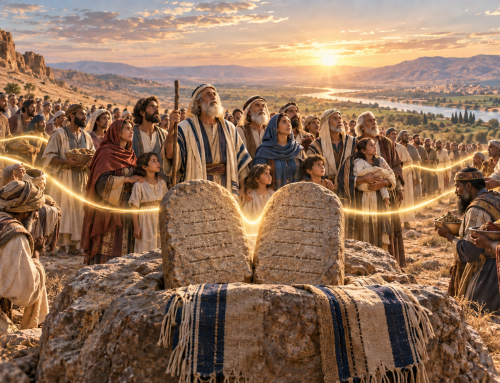
Then at last, they arrived at the wedding venue, Sinai.
Everything was ready, the facilitator of the wedding, Moses, received a message from the groom to the bride (Ex19:4-5). “You have seen what I did to the Egyptians, and how I bore you on eagles’ wings and brought you to Myself. And now, if you diligently obey My voice, and shall guard My covenant, then you shall be My treasured possession above all the peoples”.
The bride replied in one voice : “All that יהוה has spoken we shall do.”
The mountain was covered in a thick cloud that formed a canopy for the Bride and Groom to stand under before, Moses, the “minister”/ facilitator.
The bride prepared herself for the wedding by washing herself and her wedding garments, to present herself blameless and without a spot to her Groom.
Then the trumpet sounded, the thunders and lightning roared and on that loud, dramatic musical climax He came down en she walked towards the foot of the mountain.
He did not take the hand of His bride yet, for she was told to keep her distance , to see, hear, smell, but not touch. Behind a border at the foot of the mountain she had to wait.
His power manifested as He came down in fire and smoke covered the mountain and went up towards heaven. The mountain shook and the sound of the Shofar became louder and louder.
Moses , the facilitator of this marriage, went up to speak to the groom while the bride waited behind the border at the foot of the shaking, burning mountain filled with thunder, lightning, and loud sound.
He returned with a detailed message of the bride’s responsibility in this covenant relationship. No longer was He only saying, “if you diligently obey My voice, and shall guard My covenant”. He gave her detail on how to fulfil this.
Then the love story took a turn. The bride was overwhelmed by the power display by the groom and Israel turned into a runaway bride. Fear is overwhelmed her and she asked for more time, not ready for a face to face relationship with her groom yet. She did not break off the marriage but asked for more time with the Moses as mediator.
The marriage covenant was confirmed in Ex 24 :7 but Israel , still had a long journey of change before she would be able to do what she agreed to in the covenant.
But the bridegroom did not give up on the bride. If she cannot meet Him face to face yet, He would provide a way to make it easier for her to draw near to Him.
He gave detailed instructions for the building of the Tabernacle. A place where His bride could get to know Him more intimately as she crossed from one threshold to the other.
As she wondered the desert, still living in her temporary home, she would see the large white structure in the middle of the camp. The image : a reminder of herself, the bride in the desert, dressed in white , what an impressive sight this must have been.
Drawn to it , she would cross the first threshold and enter the outer court. Here she would see a vessel lined with mirrors. Looking at her own reflections, through the waters of purification, examining herself, all her imperfections would become visible to her. She was presented with the opportunity to clean herself from every spot of dirt that she could identify.
Cleansed, she would declare herself willing to put herself down on the alter and move into a more intimate relationship.
Still being assisted by the priest, she was now ready to cross the next threshold, into the holy place. A place that resembled the first encounter at Sinai. The room was filled with smoke from the altar of incense, the fire or His presence was visible in the flames of the Menorah.
No longer did she fear, she was comforted, for on the table was bread that was a reminder of his provision of Manna. These images enabled her to relax and humbly get herself ready for the next step, crossing the final threshold to the holy of holies.
Although the two cherubs on the curtains were a fast contrast to the two outside the Garden of Eden, where they were armed with swords to keep man out, away from the presence of God. Here were two cherubs on the dividing curtain encouraging, inviting the bride in.
But it was not time yet. Only the mediator, the high priest could enter on her behalf. But wow, the bride made progress. And a very loving, patient, caring groom was waiting.
Later we read that as the slavery in Egypt united the tribes into one bride, in later years she divided into two again, Israel and Judah.
The groom divorced Israel, for her adultery and backsliding (Jer 3:6-8), but He never divorced Judah, although she committed whoring too.
According to the guidelines in the Torah, if a man divorced his wife and she left him and married another man, he could not take her back. But we read about His unlimited Mercy in Jer 3:12 -14 “Go and proclaim these words toward the north, and say, ‘Return, O backsliding Yisra’ĕl,’ declares יהוה, ‘I shall not look on you in displeasure, for I am kind,’ declares יהוה, ‘and I do not bear a grudge forever. Only, acknowledge your crookedness, because you have transgressed against יהוה your Elohim, and have scattered your ways to strangers under every green tree, and you have not obeyed My voice,’ declares יהוה. Return, O backsliding children,” declares יהוה, “for I shall rule over you, and shall take you, one from a city and two from a clan, and shall bring you to Tsiyon.
In James 2:13 we read : “For the judgment is without compassion to the one who has shown no compassion. And compassion boasts over judgment.”
Although He divorced Israel, He never stopped loving her and longed for the day that he could become one flesh with her again. (Matt 19:6) A day that the two brides or sticks will become one again.
In the creation story, Adam longed for a partner, and one was taken from his side and given to him. One become two, we find the opposite here.
His ultimate character of compassion, mercy, kindness and righteousness was displayed when we saw Yeshua hanging on the cross, giving his life. His side was pierced, He gave Israel the opportunity to become one with Him again as He took her sin on Him.
Can we truly understand His love for us?
A love that we surely do not deserve.
But He is always there, waiting for our return. Giving us a helping hand if we stumble. Providing us with ways, tabernacles in our lives to make it easier for us to put our sins behind us, wash and cleanse ourselves to approach him, for one day we WILL see Him face to face, and then it will be without fear.
All to the glory of our Creator, our Father, our King!

- Noach: Through the Waters Toward Restoration October 10, 2026Central message: YHVH judges a world filled with violence, preserves life through Noach, and renews His covenant purpose. Yet the flood changes the world without changing the human heart. Humanity still needs more than another beginning—it needs inward renewal through Yeshua. The Original Setting Parashat Noach contains three major movements: The flood: Creation […]
- B’reisheet: From Darkness to Eden October 5, 2026B’reisheet introduces the great storyline of Scripture: Elohim creates a good world, humanity is called to bear His image, sin brings exile and death, yet YHVH immediately begins revealing His plan of redemption and restoration through Yeshua. The Original Setting B’reisheet contains several foundational events: Elohim creates the heavens and the earth. Light […]
- The Oath That Made a People : Nitzavim September 17, 2026A commentary on Parashah Nitzavim (Deuteronomy 29:9–30:20) Scripture quotations are from the American Standard Version (1901). Verse numbers in Deuteronomy follow the Hebrew text; English Bibles run one verse higher in this section. 1. Standing in a covenant that was sworn before you were born Nitzavim opens with Israel standing — nitzavim — […]
- Ha’azinu: Luister na die Lied van die Rots September 17, 2026Die naam Ha’azinu beteken “Luister!” Hierdie Torahgedeelte, Deuteronomium 32, bevat die lied wat Moses kort voor sy dood aan Israel geleer het. Dit herinner die volk aan YHVH se trou, waarsku hulle teen geestelike afvalligheid en eindig met die hoop op herstel en versoening. Moses begin deur sy woorde met reën en dou […]
- STAAN, KIES EN WANDEL : NITZAVIM – VAYELECH August 29, 2026Nitzavim–Vayelech : Deuteronomium 29:10–31:30 Hierdie week lees ons ’n dubbele Torah-gedeelte, Nitzavim en Vayelech, en saam bring hierdie twee gedeeltes ons by een van die aangrypendste oomblikke in die Torah. In Nitzavim–Vayelech staan Israel op die vlaktes van Moab. Die woestynreis is amper verby. Die Beloofde Land lê voor hulle. Moses weet dat […]
- WANNEER JY INKOM – KI TAVO August 24, 2026DIE KERN BOODSKAPPE VAN KI TAVO: Onthou waaruit YHVH jou gebring het, wees dankbaar vir waar Hy jou gebring het, en wanneer jy Sy seën binnestap, moenie die Gewer vergeet nie. Ki Tavo (כִּי־תָבוֹא) beteken “Wanneer jy inkom.” Israel staan op die punt om die Beloofde Land binne te gaan. Ná jare in […]
- WANNEER GELOOF DEEL WORD VAN JOU ALLEDAAGSE LEWE – KI TETZE August 16, 2026Ki Tetze (כִּי־תֵצֵא) beteken “Wanneer jy uittrek” of “Wanneer jy uitgaan.” Hierdie Torah-gedeelte bevat meer gebooie as enige ander porsie en raak ’n verstommende verskeidenheid aspekte van die alledaagse lewe aan: gesinsverhoudings, die huwelik, werk, geregtigheid, die versorging van kwesbares, eerlikheid in besigheid, goedheid teenoor diere en selfs die terugbesorging van iets wat verlore […]
- SHOFTIM – WIE REGEER MY HART? August 11, 2026Die woorde waarmee hierdie gedeelte begin, bly deur die eeue heen weerklink: “Geregtigheid, geregtigheid moet jy najaag.” Deuteronomium 16:20 Shoftim (שֹׁפְטִים) beteken “regters”. Israel staan op die drumpel van die Beloofde Land, en YHVH leer hulle dat dit nie genoeg is om die land bloot in besit te neem nie. Hulle moet daarin […]
- Kies Lewe deur die Koning te Volg – Parasha Re’eh August 5, 2026"Kyk (Re'eh), Ek hou vandag voor julle die seën en die vloek." (Deut 11:26) Die eerste woord van hierdie week se Parasha is Re'eh, wat beteken "Kyk!" Dit is merkwaardig dat Moses die volk in die enkelvoud aanspreek. Al staan die hele volk voor hom, spreek hy elke persoon individueel aan. Elkeen moes […]
- Walking in the Footsteps of Covenant – Ekev July 27, 2026The Hebrew word Ekev (עקב) literally means heel or because. It carries the beautiful picture of following in someone's footsteps. Just as a heel leaves a footprint behind, Israel was called to walk in the footsteps of YHVH's covenant. The blessings described in this parashah were not random rewards, but the natural fruit of […]