Central message: YHVH judges a world filled with violence, preserves life through Noach, and renews His covenant purpose. Yet the flood changes the world without changing the human heart. Humanity still needs more than another beginning—it needs inward renewal through Yeshua.
- The Original Setting
Parashat Noach contains three major movements:
- The flood: Creation has become corrupted and filled with violence.
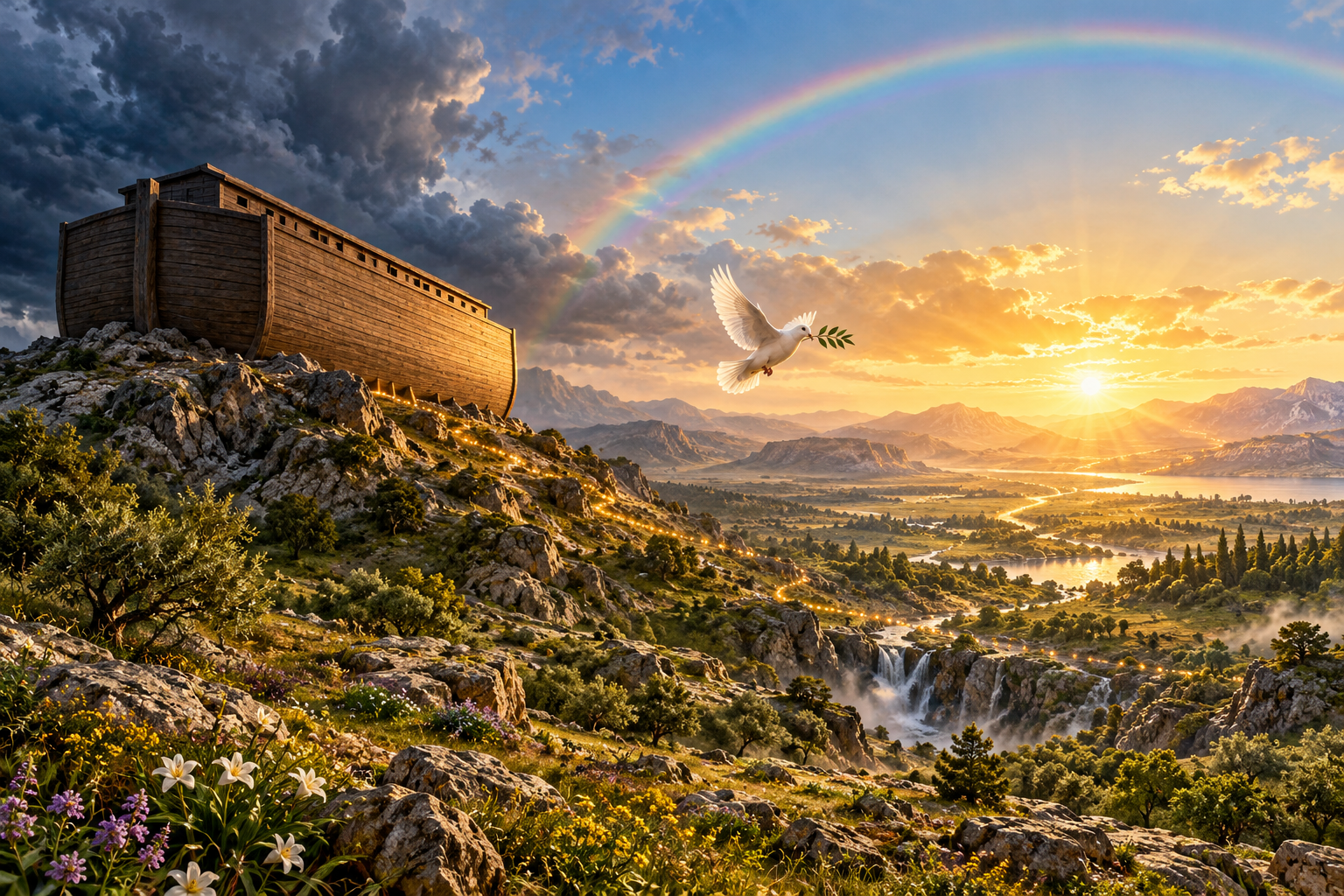
- The covenant with Noach: YHVH preserves Noach, his family and the animals, and gives the rainbow as a covenant sign.
- The tower of Babel: Humanity gathers to establish its own name and security rather than filling the earth according to YHVH’s purpose.
Noach is described as righteous and blameless in his generation, and as one who “walked with Elohim” (Genesis 6:9). While the world followed corruption, Noach listened, trusted and obeyed.
- The Eden Connection
The flood as a reversal of creation
In Genesis 1, YHVH separates the waters and brings forth dry land. During the flood, those boundaries collapse and the ordered world returns to a watery condition.
The flood is therefore pictured as a form of de-creation. But when the waters recede, dry ground appears again and creation begins anew.
Noach as a new Adam
After leaving the ark:
- Noach receives a blessing to be fruitful and multiply.
- Humanity is again given responsibility over the creatures.
- Noach becomes a worker of the soil.
- A new beginning is offered to humanity.
Noach resembles Adam, but he cannot fully reverse Adam’s failure. Sin remains present, showing that a new environment cannot produce a new heart.
The ark as preserved sacred space
The ark contains human life, animal life and the possibility of a future creation. While judgment surrounds it, YHVH preserves a small place of life within it.
This echoes Eden as a protected place of life and anticipates the Tabernacle, where YHVH’s presence and covenant purposes are preserved among His people.
Clean and unclean animals
The distinction between clean and unclean animals appears before Sinai. Noach takes additional clean animals into the ark and later offers some of them to YHVH.
This shows that the concepts of holiness, acceptable worship and distinction were already present in the earliest generations.
- The Prophetic Thread
Judgment followed by restoration
The prophets often use flood imagery when describing overwhelming judgment. Yet they also return to the covenant with Noach as evidence of YHVH’s mercy and faithfulness.
“For this is like the waters of Noach to Me…”
— Isaiah 54:9
Isaiah connects the Noachic covenant with YHVH’s promise that His covenant of peace will not be removed. Judgment is real, but it is not YHVH’s final word.
The earth filled with violence—or His glory
Before the flood, the earth was filled with violence. The prophets present the opposite destination:
“For the earth shall be filled with the knowledge of the glory of YHVH, as the waters cover the sea.”
— Habakkuk 2:14
This is a beautiful reversal. The earth that was once filled with violence will one day be filled with the knowledge of YHVH.
Babel and the kingdoms of humanity
At Babel, humanity seeks to build a city and make a name for itself. This becomes a recurring biblical picture of human kingdoms organised independently of YHVH.
The prophets anticipate a future in which the nations no longer unite in rebellion but come together to worship YHVH.
- The New Testament Connection
Yeshua and the days of Noach
Yeshua compares the time before His return to the days of Noach. People continued with ordinary life while remaining unaware of the approaching judgment.
The warning is not that ordinary activities are sinful. The danger is spiritual indifference—living as though YHVH will never intervene in human history.
Noach’s life teaches us to remain faithful even when obedience seems strange to the surrounding culture.
The ark and salvation
The ark is a picture of YHVH providing a way through judgment. Noach was not rescued because he invented an escape plan; he was rescued because he trusted YHVH’s instructions.
In the same way, salvation begins with YHVH’s initiative and is received through trusting obedience.
The flood and immersion
Peter connects the flood with immersion in 1 Peter 3:20–21. His point is not that water itself saves. Immersion represents an appeal to Elohim from a cleansed conscience through the resurrection of Yeshua.
The flood separated an old corrupted world from a new beginning. Immersion similarly pictures leaving the old life behind and entering new life in Messiah.
Noach’s name and true rest
The name Noach is connected with rest or comfort. His father hoped that Noach would bring relief from the cursed ground.
Noach brought a measure of rest, but not complete restoration. Yeshua gives the deeper rest humanity needs:
“Come to Me, all you who labour and are burdened, and I will give you rest.”
— Matthew 11:28
Noach points beyond himself to the One who provides true rest from sin and restores humanity’s relationship with the Father.
Babel and Shavuot
At Babel:
- Humanity gathers in pride.
- One language supports rebellion.
- Languages are confused.
- The people are scattered.
At Shavuot in Acts 2:
- People from many nations gather.
- The Ruach HaKodesh is poured out.
- Different languages communicate the mighty works of Elohim.
- The disciples are sent out to the nations.
Shavuot does not simply erase cultural and linguistic differences. It redirects them toward the proclamation of YHVH’s Kingdom.
- Our Response
Parashat Noach asks us:
- Can we walk faithfully with Elohim when society moves in another direction?
- Are we willing to obey before we can see the outcome?
- Is our life spreading peace and righteousness, or contributing to violence and corruption?
- Are we building YHVH’s Kingdom, or trying to make a name for ourselves?
- Have we mistaken outward change for inward transformation?
- Are we awake and spiritually prepared for Yeshua’s return?
The Breadcrumbs Through Scripture
| Noach | New Testament connection | Final restoration |
| Creation passes through water | Immersion pictures death and new life | Creation is finally renewed |
| Noach walks with Elohim | Believers are called to walk in the Spirit | YHVH dwells with humanity |
| The ark preserves life | Salvation is provided through Yeshua | Nothing unclean enters the renewed city |
| The dove signals a new beginning | The Ruach descends upon Yeshua | Creation lives fully under the Ruach |
| The rainbow marks YHVH’s covenant | YHVH remains faithful to His promises | The rainbow surrounds His throne |
| Babel scatters the nations | Shavuot sends the good news to the nations | Every nation worships before YHVH |
| Noach offers a sacrifice | Yeshua offers Himself | The curse is finally removed |
Key Thought
The flood washed the earth, but it could not cleanse the human heart. Noach brought humanity through the waters into a new beginning, but Yeshua brings us through death into new creation.

- B’reisheet: From Darkness to Eden October 5, 2026B’reisheet introduces the great storyline of Scripture: Elohim creates a good world, humanity is called to bear His image, sin brings exile and death, yet YHVH immediately begins revealing His plan of redemption and restoration through Yeshua. The Original Setting B’reisheet contains several foundational events: Elohim creates the heavens and the earth. Light […]
- The Oath That Made a People : Nitzavim September 17, 2026A commentary on Parashah Nitzavim (Deuteronomy 29:9–30:20) Scripture quotations are from the American Standard Version (1901). Verse numbers in Deuteronomy follow the Hebrew text; English Bibles run one verse higher in this section. 1. Standing in a covenant that was sworn before you were born Nitzavim opens with Israel standing — nitzavim — […]
- Ha’azinu: Luister na die Lied van die Rots September 17, 2026Die naam Ha’azinu beteken “Luister!” Hierdie Torahgedeelte, Deuteronomium 32, bevat die lied wat Moses kort voor sy dood aan Israel geleer het. Dit herinner die volk aan YHVH se trou, waarsku hulle teen geestelike afvalligheid en eindig met die hoop op herstel en versoening. Moses begin deur sy woorde met reën en dou […]
- STAAN, KIES EN WANDEL : NITZAVIM – VAYELECH August 29, 2026Nitzavim–Vayelech : Deuteronomium 29:10–31:30 Hierdie week lees ons ’n dubbele Torah-gedeelte, Nitzavim en Vayelech, en saam bring hierdie twee gedeeltes ons by een van die aangrypendste oomblikke in die Torah. In Nitzavim–Vayelech staan Israel op die vlaktes van Moab. Die woestynreis is amper verby. Die Beloofde Land lê voor hulle. Moses weet dat […]
- WANNEER JY INKOM – KI TAVO August 24, 2026DIE KERN BOODSKAPPE VAN KI TAVO: Onthou waaruit YHVH jou gebring het, wees dankbaar vir waar Hy jou gebring het, en wanneer jy Sy seën binnestap, moenie die Gewer vergeet nie. Ki Tavo (כִּי־תָבוֹא) beteken “Wanneer jy inkom.” Israel staan op die punt om die Beloofde Land binne te gaan. Ná jare in […]
- WANNEER GELOOF DEEL WORD VAN JOU ALLEDAAGSE LEWE – KI TETZE August 16, 2026Ki Tetze (כִּי־תֵצֵא) beteken “Wanneer jy uittrek” of “Wanneer jy uitgaan.” Hierdie Torah-gedeelte bevat meer gebooie as enige ander porsie en raak ’n verstommende verskeidenheid aspekte van die alledaagse lewe aan: gesinsverhoudings, die huwelik, werk, geregtigheid, die versorging van kwesbares, eerlikheid in besigheid, goedheid teenoor diere en selfs die terugbesorging van iets wat verlore […]
- SHOFTIM – WIE REGEER MY HART? August 11, 2026Die woorde waarmee hierdie gedeelte begin, bly deur die eeue heen weerklink: “Geregtigheid, geregtigheid moet jy najaag.” Deuteronomium 16:20 Shoftim (שֹׁפְטִים) beteken “regters”. Israel staan op die drumpel van die Beloofde Land, en YHVH leer hulle dat dit nie genoeg is om die land bloot in besit te neem nie. Hulle moet daarin […]
- Kies Lewe deur die Koning te Volg – Parasha Re’eh August 5, 2026"Kyk (Re'eh), Ek hou vandag voor julle die seën en die vloek." (Deut 11:26) Die eerste woord van hierdie week se Parasha is Re'eh, wat beteken "Kyk!" Dit is merkwaardig dat Moses die volk in die enkelvoud aanspreek. Al staan die hele volk voor hom, spreek hy elke persoon individueel aan. Elkeen moes […]
- Walking in the Footsteps of Covenant – Ekev July 27, 2026The Hebrew word Ekev (עקב) literally means heel or because. It carries the beautiful picture of following in someone's footsteps. Just as a heel leaves a footprint behind, Israel was called to walk in the footsteps of YHVH's covenant. The blessings described in this parashah were not random rewards, but the natural fruit of […]
- The Heart That Hears : Va’etchanan July 20, 2026The name Va'etchanan, meaning "I pleaded" or "I earnestly sought favor," reflects Moses' heartfelt plea to YHVH from the plains of Moab, begging to enter the Promised Land. Despite Elohim's loving refusal, Moses, rather than dwelling on his disappointment, dedicates his final days to preparing the Israelites for a future he will not witness. […]