I would like to share my Hanukkah journey with you. It has been a voyage filled with discovery and introspection, as well as moments of restoration and rededication.
A dear friend has crafted a beautiful Hanukkiah for me. In keeping with tradition, it proudly displays 9 candles, but mine symbolize the 9 fruits of the Holy Spirit.

Love / Ahava
Joy
Peace
Patience
Kindness / Chesed
Goodness
Faithfulness
Gentleness
Self-control
The central candle in the menorah, from which all others are lit, is known as the shamash – the servant or helper. Kindness or Chesed is positioned at the center. One might wonder, why is kindness chosen as the center instead of love?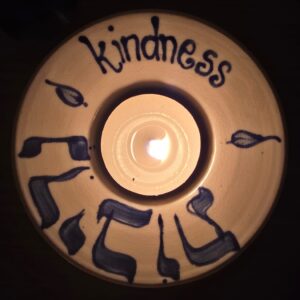
The Hebrew word translated as kindness is Chesed, which does not have a direct equivalent in English. Chesed offers valuable insights into the character of God and provides a glimpse into His redemptive plan.
Our Western mentality places a strong emphasis on feelings and emotions, causing us to find it challenging to grasp the concept of chesed, which involves taking action to assist someone in need.
The term Chesed encompasses a range of attributes, including lovingkindness, mercy, strength, grace, purity, devotion, loyalty, tenderness, compassion, and steadfastness. However, none of these individual attributes can fully capture the essence of Chesed. Chesed represents the complete character of our Creator.
Our ultimate aspiration is Chesed, the embodiment of the fruits of the Spirit that we all aspire to manifest and show to the world. Chesed represents a kindness that surpasses our limited understanding of human experiences, emotions, actions, and sentiments.
In this moment of celebrating His deliverance, hope, and our trust in Him, we are graciously reminded of His abundant loving kindness towards us. As we transfer the flame from the shamash to the remaining candles for eight consecutive nights, we take a moment to contemplate our own lives.
On day 1 we lit candle 1: Love / Ahava .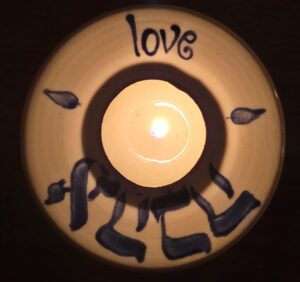
The Bible teaches us about different types / facets of love: love for our Creator, love for our neighbours, love for strangers, love for the dispossessed, love for ourselves, and romantic love. In Western culture, we often prioritise romantic love because of our emphasis on emotions and media influences from fairy tales.
Love is like a cut diamond. It has many facets. Love can transform the hardest stone into a shiny gem. However, this transformation is a process.
- An expert examines the rough diamond to determine the correct cut. No two diamonds are alike.
- The cleaving process comes next. In the past, a different diamond was used to create a groove (before laser technology).
- The stone is prepared to be sawed. A bronze blade can enter the groove to remove all the weaknesses in the stone.
- Now that the weaknesses have been addressed, the shaping process can begin.
- The stone is faceted using discs dusted with diamond. This meticulous process is carried out by skilled hands and involves continuous inspection. Faceting the stone plays a crucial role in determining the ultimate appearance of the diamond.
- The process of faceting often results in sharp edges on the rounded surface. To achieve a smoother finish, two diamonds are placed in a bruting machine where they are bumped against each other. This action helps to round and smooth out the edges.
- The piece is now prepared for polishing with diamond dust, which will enhance its ability to reflect light and shine brilliantly for everyone to admire.
When we surrender our lives to Father and declare Him as our King, we present Him with a rough stone for His inspection. He possesses the ability to perceive its true potential, and with genuine, untainted love, He initiates a plan to transform us into radiant gems. In doing so, we become vessels of His image and can radiate His pure love to everyone around us.
He cleaves our hearts by circumcising it. With circumcised hearts we stand prepared to enter the outer court of His presence. It is here that a bronze instrument skilfully removes the damages and broken layers that obscure the purity within us, like a hidden gem. We confront the baggage we have accumulated throughout our lives, facing it head-on within the confines of the bronze laver. As we gaze upon our true reflections, we are filled with a readiness to sacrifice ourselves upon the bronze altar, allowing the flames to consume all that lacks Kingdom Value.
After the cutting process the Gem cutter begins by faceting the diamond and then proceeds to polish it. This meticulous process is carried out in small sections, with each interaction being closely examined. A disc coated with diamond dust, collected from other diamonds that have undergone the same procedure, is used at every step.
In the realm of the Gem Cutter, we find ourselves anchored yet moulded by those who surround us. It is through the collective experiences of our fellow believers that we are shaped and refined, like precious gems, to reveal our true brilliance.
Once you believe that you have achieved perfection and refinement, there comes a moment when He guides you through a bruting machine. The purpose is not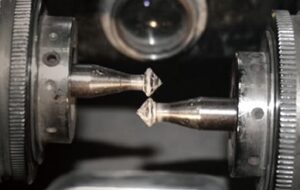 to inflict punishment upon you, but rather to eliminate any sharp edges that could potentially harm others. This process typically involves the presence of another individual, such as a mentor or a trusted friend. Although it may resemble a boxing match, with two diamonds colliding, its true intention is to shape and mould us, ultimately making us more well-rounded individuals.
We will resume polishing after this, followed by the meticulous examination of the gemmologist’s expert eye. This is not a simple shine check; each facet is thoroughly inspected one by one. Our love for our Creator, love for our neighbours, love for strangers, love for the dispossessed, and love for ourselves and more – all these aspects need to be refined to perfection in order for us to truly grasp the profound depths of His love for us.
All to the Glory of our Creater , our King!
To be continued …….


- B’reisheet: From Darkness to Eden October 5, 2026B’reisheet introduces the great storyline of Scripture: Elohim creates a good world, humanity is called to bear His image, sin brings exile and death, yet YHVH immediately begins revealing His plan of redemption and restoration through Yeshua. The Original Setting B’reisheet contains several foundational events: Elohim creates the heavens and the earth. Light […]
- The Oath That Made a People : Nitzavim September 17, 2026A commentary on Parashah Nitzavim (Deuteronomy 29:9–30:20) Scripture quotations are from the American Standard Version (1901). Verse numbers in Deuteronomy follow the Hebrew text; English Bibles run one verse higher in this section. 1. Standing in a covenant that was sworn before you were born Nitzavim opens with Israel standing — nitzavim — […]
- Ha’azinu: Luister na die Lied van die Rots September 17, 2026Die naam Ha’azinu beteken “Luister!” Hierdie Torahgedeelte, Deuteronomium 32, bevat die lied wat Moses kort voor sy dood aan Israel geleer het. Dit herinner die volk aan YHVH se trou, waarsku hulle teen geestelike afvalligheid en eindig met die hoop op herstel en versoening. Moses begin deur sy woorde met reën en dou […]
- STAAN, KIES EN WANDEL : NITZAVIM – VAYELECH August 29, 2026Nitzavim–Vayelech : Deuteronomium 29:10–31:30 Hierdie week lees ons ’n dubbele Torah-gedeelte, Nitzavim en Vayelech, en saam bring hierdie twee gedeeltes ons by een van die aangrypendste oomblikke in die Torah. In Nitzavim–Vayelech staan Israel op die vlaktes van Moab. Die woestynreis is amper verby. Die Beloofde Land lê voor hulle. Moses weet dat […]
- WANNEER JY INKOM – KI TAVO August 24, 2026DIE KERN BOODSKAPPE VAN KI TAVO: Onthou waaruit YHVH jou gebring het, wees dankbaar vir waar Hy jou gebring het, en wanneer jy Sy seën binnestap, moenie die Gewer vergeet nie. Ki Tavo (כִּי־תָבוֹא) beteken “Wanneer jy inkom.” Israel staan op die punt om die Beloofde Land binne te gaan. Ná jare in […]
- WANNEER GELOOF DEEL WORD VAN JOU ALLEDAAGSE LEWE – KI TETZE August 16, 2026Ki Tetze (כִּי־תֵצֵא) beteken “Wanneer jy uittrek” of “Wanneer jy uitgaan.” Hierdie Torah-gedeelte bevat meer gebooie as enige ander porsie en raak ’n verstommende verskeidenheid aspekte van die alledaagse lewe aan: gesinsverhoudings, die huwelik, werk, geregtigheid, die versorging van kwesbares, eerlikheid in besigheid, goedheid teenoor diere en selfs die terugbesorging van iets wat verlore […]
- SHOFTIM – WIE REGEER MY HART? August 11, 2026Die woorde waarmee hierdie gedeelte begin, bly deur die eeue heen weerklink: “Geregtigheid, geregtigheid moet jy najaag.” Deuteronomium 16:20 Shoftim (שֹׁפְטִים) beteken “regters”. Israel staan op die drumpel van die Beloofde Land, en YHVH leer hulle dat dit nie genoeg is om die land bloot in besit te neem nie. Hulle moet daarin […]
- Kies Lewe deur die Koning te Volg – Parasha Re’eh August 5, 2026"Kyk (Re'eh), Ek hou vandag voor julle die seën en die vloek." (Deut 11:26) Die eerste woord van hierdie week se Parasha is Re'eh, wat beteken "Kyk!" Dit is merkwaardig dat Moses die volk in die enkelvoud aanspreek. Al staan die hele volk voor hom, spreek hy elke persoon individueel aan. Elkeen moes […]
- Walking in the Footsteps of Covenant – Ekev July 27, 2026The Hebrew word Ekev (עקב) literally means heel or because. It carries the beautiful picture of following in someone's footsteps. Just as a heel leaves a footprint behind, Israel was called to walk in the footsteps of YHVH's covenant. The blessings described in this parashah were not random rewards, but the natural fruit of […]
- The Heart That Hears : Va’etchanan July 20, 2026The name Va'etchanan, meaning "I pleaded" or "I earnestly sought favor," reflects Moses' heartfelt plea to YHVH from the plains of Moab, begging to enter the Promised Land. Despite Elohim's loving refusal, Moses, rather than dwelling on his disappointment, dedicates his final days to preparing the Israelites for a future he will not witness. […]