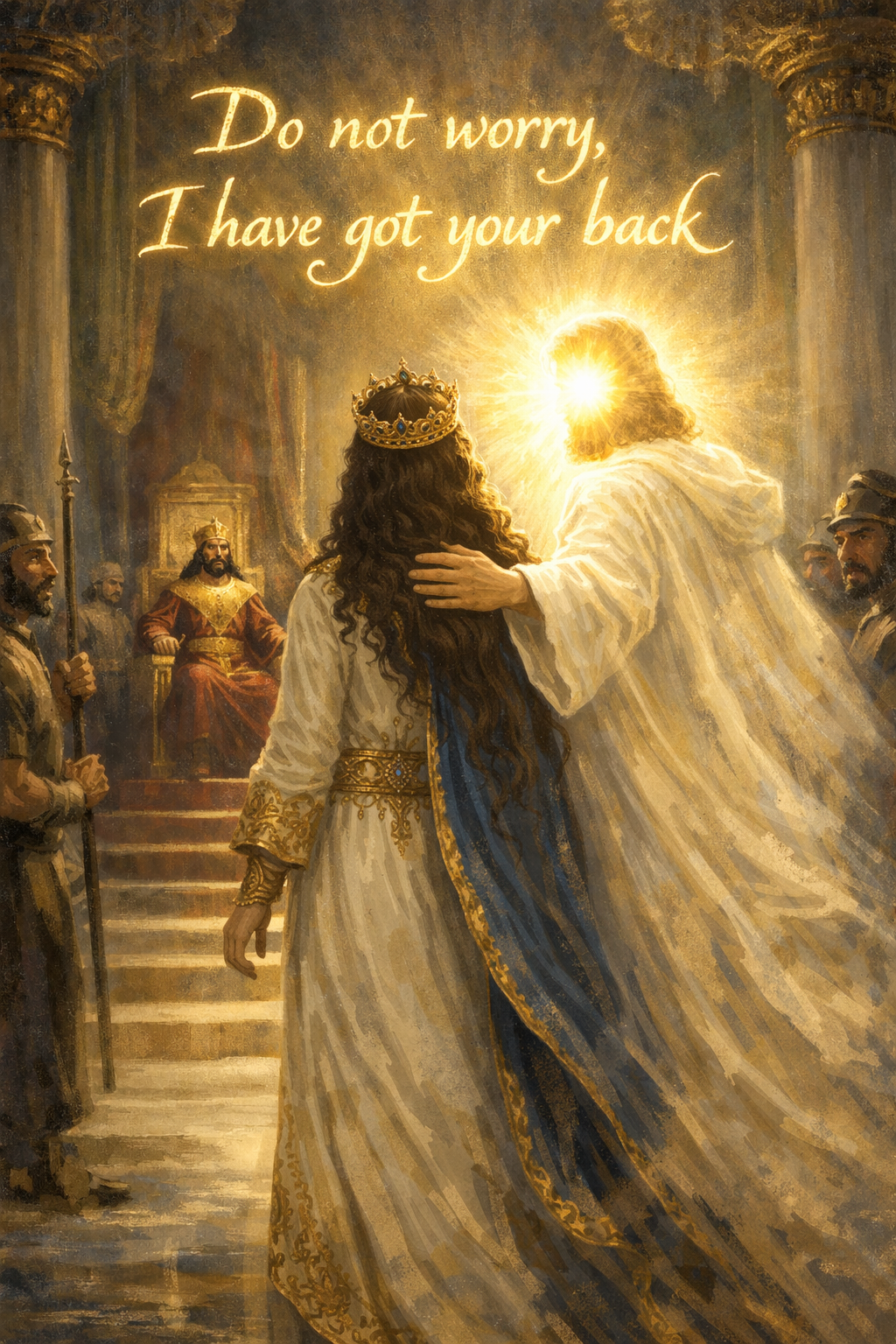
When I was growing up, we owned several children’s Bibles, published by the Seventh-day Adventists, which featured incredibly beautiful illustrations. The sixth book showed signs of use because it was my absolute favorite. The story was about Queen Esther. The scene of Esther entering the throne room unannounced is still vivid in my memory. Her dress, a vibrant mix of yellow and orange, cascaded onto the floor. An arm adorned with jewellery, reaching out to the scepter extended to her from the throne.
My childhood imagination was filled with the image of a heroine. Never did I imagine that her chin might have trembled with hidden fear. But she was not alone! In this season of Purim the message I’m taking away, is that even when fear whispers, God stands behind you.
At some point, we all hear the whispers of fear, it might even shout at us from time to time. We all carry responsibilities, face failed expectations and harbor silent worries about our families, finances, health, or the future.
However, our Heavenly Father never intended for us to bear these burdens without support. 1 Peter 5:7 states, “…casting all your worry upon Him, for He is concerned about you.” This necessitates humility under God’s powerful hand. Admitting your need help is a sign of humility. It’s not about avoiding accountability; it’s about acting diligently and practically while relying on God for the ultimate conclusion.
Isaiah 41:10 states, “Do not fear, for I am with you.” This verse is truly uplifting. God is not a distant observer. He stands close. He supports. He protects. God doesn’t stand before you and demand that you be strong. He is before you clearing the path and behind you, as a protector of the unseen.
While not explicitly mentioned, God’s presence and actions are unmistakably present in the Book of Esther. This principle can be applied to our lives. God’s presence is always evident, even if His name is sometimes concealed. This is evident in His divine timing and protection. When there is silence, God is still working to bring help into your life from unseen places.
This principle is in agreement with Deuteronomy 31:8, which declares, “And it is יהוה who is going before you;” He not only prepares the way forward but also stays behind to watch over your steps. His presence envelops us; we are never left unprotected.
However, we are all human, and at times we struggle internally between worry and trust. Have you never pondered the possibility of failure? What if it falls apart? Have you ever experienced feelings of isolation, invisibility, or a lack of support, despite being surrounded by others? In Matthew 6:34a, Yeshua addressed these concerns by stating, “Do not, then, worry about tomorrow…” This passage essentially restates King David’s words from Psalm 23: “The Lord is my shepherd, I lack nothing. “
Last night, while re-reading the Scroll of Esther, Father reaffirmed this lesson to me that I’m eager to share with you.
Psalm 5 states that favor surrounds us like a shield. But always remember, the protection Father offers is unique to each of us, not a one-size-fits-all safeguard. He is intimately acquainted with each of us, knowing our names, our histories, and our present situations. He witnesses our sorrows and hears even our unspoken prayers. Our protector’s watch is ceaseless; He never turns His eyes.
So I want to encourage you when doubt fear and unbelief knock on the door of your heart. Pause , Pray and declare the truth of His Word. Declare out loud : “God stands behind me. I am not alone. I am covered.”
God has your back, because He has your heart, you are engraved on the palms of His hands (Isaiah 14:16).
I will not worry.
I am not alone.
I am not forgotten.
I am not overlooked.
I am protected.
I am loved.
I am permanently held.
I am a child of the Most High God.
God goes before me.
God stands behind me.
God has got my back.
All to the glory of our Protector , our loving Father , our Creator, our King.

- B’reisheet: From Darkness to Eden October 5, 2026B’reisheet introduces the great storyline of Scripture: Elohim creates a good world, humanity is called to bear His image, sin brings exile and death, yet YHVH immediately begins revealing His plan of redemption and restoration through Yeshua. The Original Setting B’reisheet contains several foundational events: Elohim creates the heavens and the earth. Light […]
- The Oath That Made a People : Nitzavim September 17, 2026A commentary on Parashah Nitzavim (Deuteronomy 29:9–30:20) Scripture quotations are from the American Standard Version (1901). Verse numbers in Deuteronomy follow the Hebrew text; English Bibles run one verse higher in this section. 1. Standing in a covenant that was sworn before you were born Nitzavim opens with Israel standing — nitzavim — […]
- Ha’azinu: Luister na die Lied van die Rots September 17, 2026Die naam Ha’azinu beteken “Luister!” Hierdie Torahgedeelte, Deuteronomium 32, bevat die lied wat Moses kort voor sy dood aan Israel geleer het. Dit herinner die volk aan YHVH se trou, waarsku hulle teen geestelike afvalligheid en eindig met die hoop op herstel en versoening. Moses begin deur sy woorde met reën en dou […]
- STAAN, KIES EN WANDEL : NITZAVIM – VAYELECH August 29, 2026Nitzavim–Vayelech : Deuteronomium 29:10–31:30 Hierdie week lees ons ’n dubbele Torah-gedeelte, Nitzavim en Vayelech, en saam bring hierdie twee gedeeltes ons by een van die aangrypendste oomblikke in die Torah. In Nitzavim–Vayelech staan Israel op die vlaktes van Moab. Die woestynreis is amper verby. Die Beloofde Land lê voor hulle. Moses weet dat […]
- WANNEER JY INKOM – KI TAVO August 24, 2026DIE KERN BOODSKAPPE VAN KI TAVO: Onthou waaruit YHVH jou gebring het, wees dankbaar vir waar Hy jou gebring het, en wanneer jy Sy seën binnestap, moenie die Gewer vergeet nie. Ki Tavo (כִּי־תָבוֹא) beteken “Wanneer jy inkom.” Israel staan op die punt om die Beloofde Land binne te gaan. Ná jare in […]
- WANNEER GELOOF DEEL WORD VAN JOU ALLEDAAGSE LEWE – KI TETZE August 16, 2026Ki Tetze (כִּי־תֵצֵא) beteken “Wanneer jy uittrek” of “Wanneer jy uitgaan.” Hierdie Torah-gedeelte bevat meer gebooie as enige ander porsie en raak ’n verstommende verskeidenheid aspekte van die alledaagse lewe aan: gesinsverhoudings, die huwelik, werk, geregtigheid, die versorging van kwesbares, eerlikheid in besigheid, goedheid teenoor diere en selfs die terugbesorging van iets wat verlore […]
- SHOFTIM – WIE REGEER MY HART? August 11, 2026Die woorde waarmee hierdie gedeelte begin, bly deur die eeue heen weerklink: “Geregtigheid, geregtigheid moet jy najaag.” Deuteronomium 16:20 Shoftim (שֹׁפְטִים) beteken “regters”. Israel staan op die drumpel van die Beloofde Land, en YHVH leer hulle dat dit nie genoeg is om die land bloot in besit te neem nie. Hulle moet daarin […]
- Kies Lewe deur die Koning te Volg – Parasha Re’eh August 5, 2026"Kyk (Re'eh), Ek hou vandag voor julle die seën en die vloek." (Deut 11:26) Die eerste woord van hierdie week se Parasha is Re'eh, wat beteken "Kyk!" Dit is merkwaardig dat Moses die volk in die enkelvoud aanspreek. Al staan die hele volk voor hom, spreek hy elke persoon individueel aan. Elkeen moes […]
- Walking in the Footsteps of Covenant – Ekev July 27, 2026The Hebrew word Ekev (עקב) literally means heel or because. It carries the beautiful picture of following in someone's footsteps. Just as a heel leaves a footprint behind, Israel was called to walk in the footsteps of YHVH's covenant. The blessings described in this parashah were not random rewards, but the natural fruit of […]
- The Heart That Hears : Va’etchanan July 20, 2026The name Va'etchanan, meaning "I pleaded" or "I earnestly sought favor," reflects Moses' heartfelt plea to YHVH from the plains of Moab, begging to enter the Promised Land. Despite Elohim's loving refusal, Moses, rather than dwelling on his disappointment, dedicates his final days to preparing the Israelites for a future he will not witness. […]