Central message: Chayei Sarah begins with death, but it is filled with signs of continuing life. Sarah is buried in the promised land, a bride is found for Isaac, and the covenant moves into the next generation. YHVH’s promises continue even when faithful people die.
- The Original Setting
Chayei Sarah means “The Life of Sarah,” yet the parashah begins by recording Sarah’s death.
The major events are:
- Sarah dies at Hebron.
- Abraham mourns for her.
- Abraham purchases the cave and field of Machpelah.
- Abraham sends his servant to find a wife for Isaac.
- The servant prays for YHVH’s guidance.
- Rebekah demonstrates hospitality and generosity.
- Rebekah willingly leaves her family to marry Isaac.
- Isaac receives Rebekah near Beer Lahai Roi.
- Abraham marries Keturah and has additional children.
- Abraham dies and is buried by Isaac and Ishmael.
- Ishmael’s descendants are listed.
- The covenant promise continues through Isaac.
Although Sarah and Abraham both die in this portion, YHVH’s covenant does not die with them.
- The Life of Sarah
Sarah’s life was marked by both weakness and faith.
She experienced:
- Barrenness and long waiting
- Fear and human attempts to fulfil the promise
- Laughter of doubt
- The miraculous birth of Isaac
- Laughter transformed into joy
- The fulfilment of what had once seemed impossible
Hebrews remembers Sarah as a woman who received strength to conceive because she considered YHVH faithful to His promise.
The title Chayei Sarah—The Life of Sarah reminds us that a faithful life is not measured only by its final moment. Sarah’s influence continued through Isaac and through the covenant promise.
Her death did not cancel what YHVH had begun through her.
- Mourning with Hope
Abraham mourned and wept for Sarah. Scripture does not portray grief as a failure of faith.
Abraham had walked with Sarah through:
- Leaving their homeland
- Famine and danger
- Years of barrenness
- Mistakes and restoration
- The birth of Isaac
- The unfolding covenant promise
Faith does not require us to deny pain. Abraham wept because Sarah mattered.
Yet he did not mourn without hope. His next action demonstrated his confidence that YHVH would fulfil His promise beyond death.
- The First Piece of the Promised Land
Although YHVH had promised the entire land to Abraham’s descendants, Abraham still described himself as a stranger and sojourner.
He purchased the field and cave of Machpelah from Ephron the Hittite as a burial place for Sarah.
This was significant because:
- It was Abraham’s first legally secured possession in the land.
- It became the family burial place of Abraham, Sarah, Isaac, Rebekah, Jacob and Leah.
- It demonstrated that Abraham believed his family belonged in the promised land.
- The grave became a declaration that death would not cancel YHVH’s promise.
Abraham refused Ephron’s initial offer of the field as a gift and paid the full price publicly. He wanted the ownership to be clear and indisputable.
The first piece of the promised land was not a palace, farm or city. It was a tomb.
Yet even that tomb became a seed of hope.
- The Eden Connection
Death outside the garden
Death entered the human story after Adam and Chavah were exiled from Eden. Sarah’s tomb reminds us that humanity still lives under the consequences of the fall.
But the tomb is located inside the land of promise.
This creates a powerful tension: death is present, but so is YHVH’s promise of restoration.
A field, a cave and future hope
Abraham purchases a field containing trees and a cave. The imagery quietly recalls Eden—land, trees, life and death.
The land has not yet been fully inherited, but Abraham places Sarah there in faith. He believes that YHVH’s promise extends beyond what he can presently see.
A bride continues the promise
After Sarah’s death, the story turns toward finding a bride for Isaac. The covenant family must continue.
Death does not have the final word. YHVH brings Rebekah into the story so that life, fruitfulness and the promised Seed can move forward.
- Abraham Sends His Servant
Abraham commissions his senior servant to find a wife for Isaac from among Abraham’s extended family.
The servant receives clear boundaries:
- Isaac must not marry a Canaanite woman.
- The bride must be willing to come.
- Isaac must not be taken back to Mesopotamia.
This is crucial. Abraham had been called out of that land. The covenant could not move forward by returning permanently to the old life.
The bride would need to leave her familiar world and join Isaac in the land of promise.
- The Servant’s Dependence on YHVH
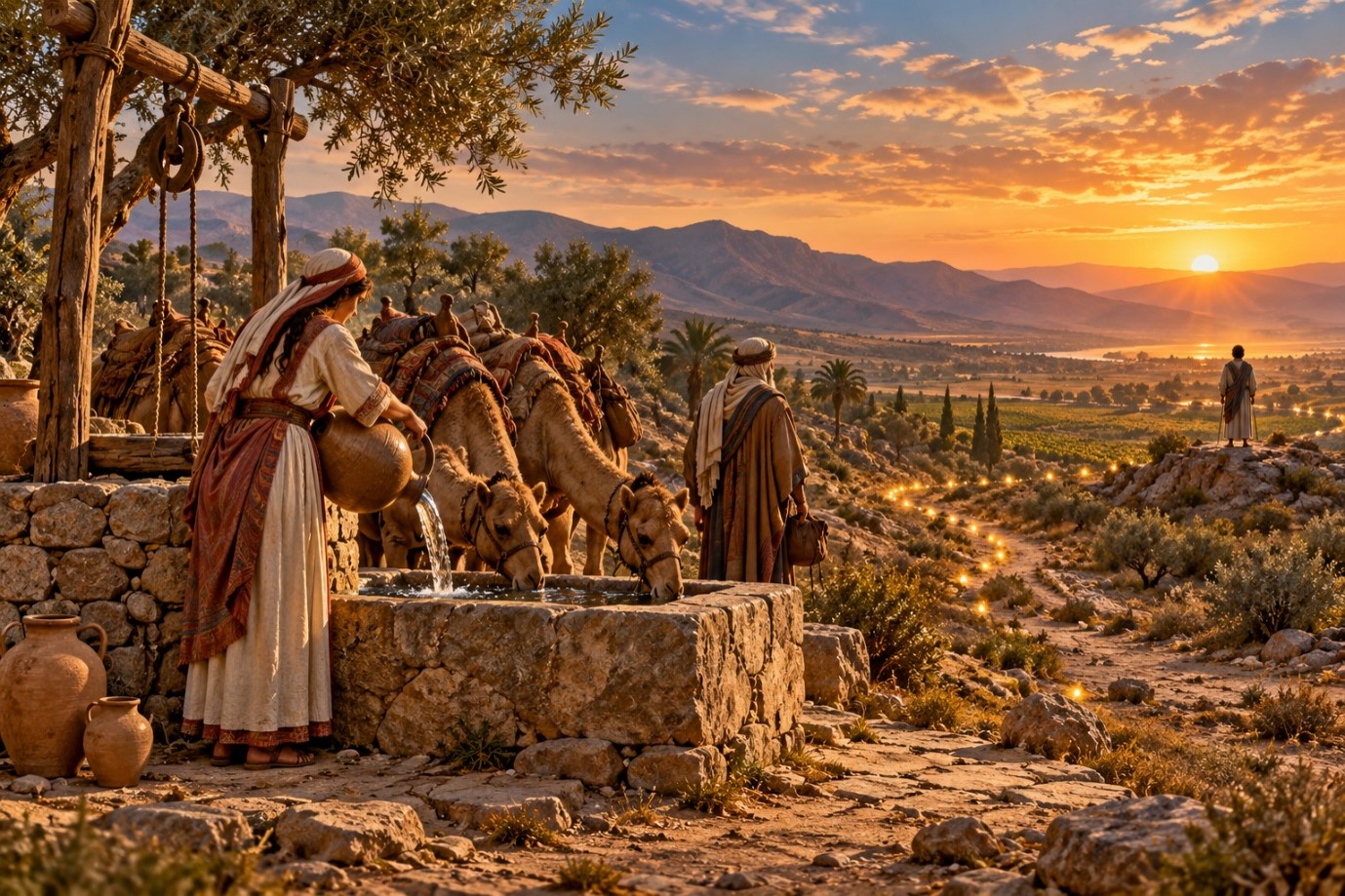
When the servant reaches the well, he prays for guidance.
His prayer is not merely for a woman who will offer him water. He asks for someone willing to water his camels as well.
A thirsty camel can drink a large quantity of water. Rebekah’s offer therefore reveals much more than politeness. It demonstrates:
- Generosity
- Initiative
- Strength
- Perseverance
- Hospitality
- A servant’s heart
The servant watches her carefully to determine whether YHVH has prospered his journey.
He does not rush ahead of YHVH. He prays, observes and waits for confirmation.
- Rebekah at the Well
Wells often become important meeting places in Scripture. They are associated with provision, relationships and covenant encounters.
At the well, Rebekah reveals her character through her actions before she knows anything about the servant’s mission.
She serves a stranger and cares for his animals without being promised any reward.
Her actions show that character is often revealed in ordinary moments. Rebekah was not trying to appear suitable for a great calling. She was simply acting according to who she was.
Her hidden faithfulness prepared her for a covenant purpose she could not yet see.
- “I Will Go”
When Rebekah’s family asks whether she is willing to leave immediately, she answers:
“I will go.”
Her response echoes Abraham’s earlier call in Lech Lecha.
Abraham left:
- His country
- His relatives
- His father’s household
- The familiar world behind him
Rebekah is now called to make a similar journey.
She has not seen Isaac. She does not know the details of her future. Yet she hears the testimony, recognises YHVH’s direction and chooses to go.
Her faith is active. She leaves what she knows to participate in a promise she has only heard about.
- Rebekah as a Bride of Promise
Rebekah is not forced to go. Her willingness is essential.
She receives gifts, leaves her household and follows the servant toward the bridegroom.
This creates a beautiful biblical pattern:
- The father sends the servant.
- The servant testifies about the son.
- The bride hears the message.
- She receives gifts.
- She chooses to leave her old life.
- The servant guides her on the journey.
- She finally meets the bridegroom.
Many Messianic readers see in this a pattern that points toward the Father, the Ruach HaKodesh, Yeshua and the covenant people called to become His bride.
This should be understood as a pattern rather than an explicit identification of every detail. Nevertheless, the similarities are meaningful.
- The Bridegroom in the Field
As Rebekah approaches, Isaac is in the field toward evening. He looks up and sees the camels approaching.
Rebekah also looks up and sees Isaac.
Their meeting brings together:
- The son of promise
- The willing bride
- The faithful servant
- The land of inheritance
- The continuing covenant
Isaac takes Rebekah into Sarah’s tent. She becomes his wife, he loves her, and he is comforted after his mother’s death.
The movement is beautiful:
Death → a journey of faith → the arrival of the bride → love and comfort → the continuation of life.
- The Prophetic Thread
The bride who leaves her former household
Psalm 45 describes a royal bride being called to leave her former household and enter the presence of the king.
The prophets also describe YHVH’s covenant relationship with His people using marriage imagery. Israel is pictured as a bride called into faithfulness, love and covenant loyalty.
Rebekah’s journey therefore participates in a larger biblical theme: YHVH calls a people away from their former identity and into covenant relationship.
Comfort after mourning
Isaiah repeatedly connects restoration with comfort:
“Comfort, comfort My people,” says your Elohim.
— Isaiah 40:1
Isaac’s comfort after Sarah’s death anticipates the prophetic hope that YHVH will comfort His people after grief, exile and loss.
The land and resurrection hope
The patriarchs were buried in the promised land because they believed YHVH’s covenant extended beyond their own lifetimes.
The prophets later speak of resurrection, restored land and the gathering of YHVH’s people. The burial place at Machpelah silently declares that death will not prevent YHVH from keeping His Word.
- The New Testament Connection
Abraham the pilgrim
Hebrews explains that Abraham lived as a stranger in the land of promise while looking for a greater city whose builder is Elohim.
He died without seeing the complete fulfilment, yet he remained convinced that YHVH was faithful.
The purchase of Machpelah demonstrates this pilgrim faith. Abraham planted his hope in the land even through burial.
Faith beyond death
Yeshua teaches that YHVH is not the Elohim of the dead but of the living—the Elohim of Abraham, Isaac and Jacob.
The covenant relationship is not erased by physical death.
Sarah’s burial and the patriarchal tomb point forward to the resurrection hope revealed more fully through Yeshua.
The beloved bridegroom
The New Testament presents Yeshua as the Bridegroom.
Like Rebekah, those who respond to Him:
- Hear testimony concerning a Bridegroom they have not yet seen.
- Receive the gifts of the Ruach.
- Leave their former allegiance.
- Begin a journey of faith.
- Wait for the Bridegroom’s appearing.
Peter writes that although we have not seen Yeshua, we love Him and rejoice in faith.
The work of the Ruach
The servant does not draw attention to himself. His mission is to speak about Abraham’s son and bring the bride to him.
Similarly, Yeshua says that the Ruach HaKodesh will glorify Him, reveal what belongs to Him and guide His people into truth.
The servant’s gifts can also remind us of the gifts and deposit of the Ruach, assuring believers that they belong to the coming Bridegroom.
Again, this is a typological pattern rather than a direct statement that the servant is the Ruach HaKodesh.
The bride prepares
Revelation describes the marriage supper of the Lamb and a bride who has made herself ready.
Rebekah’s story asks whether we are merely interested in the Bridegroom’s gifts or genuinely willing to leave the old life and journey toward Him.
- Abraham’s Final Years
After Sarah’s death and Isaac’s marriage, Abraham marries Keturah and has more children.
Before his death, Abraham gives gifts to these sons but sends them eastward, away from Isaac. Isaac remains the covenant heir.
This does not mean YHVH has no care or purpose for the other descendants. It means the specific covenant line through which the promised Seed will come continues through Isaac.
Abraham gives all that he has to Isaac and dies at a good old age.
Isaac and Ishmael come together to bury their father in the cave of Machpelah. Abraham is laid beside Sarah in the land he had purchased by faith.
- The Covenant Continues
Genesis 25:11 says:
“After the death of Abraham, Elohim blessed his son Isaac.”
This is one of the most important statements in the parashah.
Abraham dies, but YHVH’s blessing continues.
The covenant does not depend upon the earthly life of one person. Each generation has a role, but YHVH remains the true keeper of the promise.
The story moves from Abraham to Isaac, and eventually through Israel toward Yeshua.
- The Breadcrumbs Through Scripture
| Chayei Sarah | New Testament connection | Final restoration |
| Sarah dies in the land of promise | Believers grieve with resurrection hope | Death will be no more |
| Abraham purchases a burial field | Abraham looks for the city built by Elohim | The renewed earth becomes the inheritance |
| The father sends his servant | The Father sends the Ruach to testify of Yeshua | The bride is gathered to the Bridegroom |
| The servant speaks about the son | The Ruach glorifies Yeshua | All creation recognises the Son |
| Rebekah receives gifts | Believers receive the gifts and deposit of the Ruach | The bride receives her full inheritance |
| Rebekah says, “I will go” | Believers follow Yeshua by faith | The bride enters the promised dwelling |
| Isaac waits in the field | Yeshua is the coming Bridegroom | Messiah receives His prepared bride |
| Isaac is comforted | Yeshua comforts those who mourn | Every tear is wiped away |
| Abraham dies, but the blessing continues | Yeshua lives eternally as covenant guarantee | YHVH’s promises are completely fulfilled |
Key Thought
Chayei Sarah begins at a tomb but ends with the covenant moving forward. The grave cannot stop the promise, and death cannot cancel the Word of YHVH.
Sarah’s burial declares faith in the land. Rebekah’s journey declares faith in a bridegroom she has not yet seen. Together they leave breadcrumbs pointing toward resurrection, covenant fulfilment and the Bridegroom who will gather His people.

- Vayera: The Promised Son and the Elohim Who Provides October 25, 2026Central message in Vayera: YHVH reveals Himself as the One who sees, visits, judges, shows mercy and fulfills what appears impossible. The promised son is born, Abraham intercedes for the wicked, and on Mount Moriah YHVH provides a substitute—leaving powerful breadcrumbs that lead toward Yeshua. The Original Setting Vayera means “And He appeared.” […]
- Lech Lecha: Following the Call Back to the Promise October 17, 2026Central message: YHVH calls Abram out of his familiar world and leads him toward an unseen promise. Through Abram’s faith journey, YHVH begins reversing the scattering, curse and separation introduced in the opening chapters of Genesis. His purpose is not merely to bless one man, but to bring blessing to all the families of […]
- Noach: Through the Waters Toward Restoration October 10, 2026Central message: YHVH judges a world filled with violence, preserves life through Noach, and renews His covenant purpose. Yet the flood changes the world without changing the human heart. Humanity still needs more than another beginning—it needs inward renewal through Yeshua. The Original Setting Parashat Noach contains three major movements: The flood: Creation […]
- B’reisheet: From Darkness to Eden October 5, 2026B’reisheet introduces the great storyline of Scripture: Elohim creates a good world, humanity is called to bear His image, sin brings exile and death, yet YHVH immediately begins revealing His plan of redemption and restoration through Yeshua. The Original Setting B’reisheet contains several foundational events: Elohim creates the heavens and the earth. Light […]
- The Oath That Made a People : Nitzavim September 17, 2026A commentary on Parashah Nitzavim (Deuteronomy 29:9–30:20) Scripture quotations are from the American Standard Version (1901). Verse numbers in Deuteronomy follow the Hebrew text; English Bibles run one verse higher in this section. 1. Standing in a covenant that was sworn before you were born Nitzavim opens with Israel standing — nitzavim — […]
- Ha’azinu: Luister na die Lied van die Rots September 17, 2026Die naam Ha’azinu beteken “Luister!” Hierdie Torahgedeelte, Deuteronomium 32, bevat die lied wat Moses kort voor sy dood aan Israel geleer het. Dit herinner die volk aan YHVH se trou, waarsku hulle teen geestelike afvalligheid en eindig met die hoop op herstel en versoening. Moses begin deur sy woorde met reën en dou […]
- STAAN, KIES EN WANDEL : NITZAVIM – VAYELECH August 29, 2026Nitzavim–Vayelech : Deuteronomium 29:10–31:30 Hierdie week lees ons ’n dubbele Torah-gedeelte, Nitzavim en Vayelech, en saam bring hierdie twee gedeeltes ons by een van die aangrypendste oomblikke in die Torah. In Nitzavim–Vayelech staan Israel op die vlaktes van Moab. Die woestynreis is amper verby. Die Beloofde Land lê voor hulle. Moses weet dat […]
- WANNEER JY INKOM – KI TAVO August 24, 2026DIE KERN BOODSKAPPE VAN KI TAVO: Onthou waaruit YHVH jou gebring het, wees dankbaar vir waar Hy jou gebring het, en wanneer jy Sy seën binnestap, moenie die Gewer vergeet nie. Ki Tavo (כִּי־תָבוֹא) beteken “Wanneer jy inkom.” Israel staan op die punt om die Beloofde Land binne te gaan. Ná jare in […]
- WANNEER GELOOF DEEL WORD VAN JOU ALLEDAAGSE LEWE – KI TETZE August 16, 2026Ki Tetze (כִּי־תֵצֵא) beteken “Wanneer jy uittrek” of “Wanneer jy uitgaan.” Hierdie Torah-gedeelte bevat meer gebooie as enige ander porsie en raak ’n verstommende verskeidenheid aspekte van die alledaagse lewe aan: gesinsverhoudings, die huwelik, werk, geregtigheid, die versorging van kwesbares, eerlikheid in besigheid, goedheid teenoor diere en selfs die terugbesorging van iets wat verlore […]
- SHOFTIM – WIE REGEER MY HART? August 11, 2026Die woorde waarmee hierdie gedeelte begin, bly deur die eeue heen weerklink: “Geregtigheid, geregtigheid moet jy najaag.” Deuteronomium 16:20 Shoftim (שֹׁפְטִים) beteken “regters”. Israel staan op die drumpel van die Beloofde Land, en YHVH leer hulle dat dit nie genoeg is om die land bloot in besit te neem nie. Hulle moet daarin […]