Central message: Toldot follows the covenant promise into the next generation. Isaac and Rebekah face barrenness, their sons struggle before birth, Esau despises his birthright, and Jacob seeks the blessing through deception. The parashah reveals YHVH’s sovereign purpose, the value of covenant inheritance and the painful consequences of trying to obtain through human schemes what YHVH has already promised.
- The Original Setting
Toldot means “generations,” “descendants” or “family history.”
The major events include:
- Isaac prays for the barren Rebekah.
- Rebekah conceives twins who struggle within her.
- YHVH reveals that two nations are in her womb.
- Esau and Jacob are born.
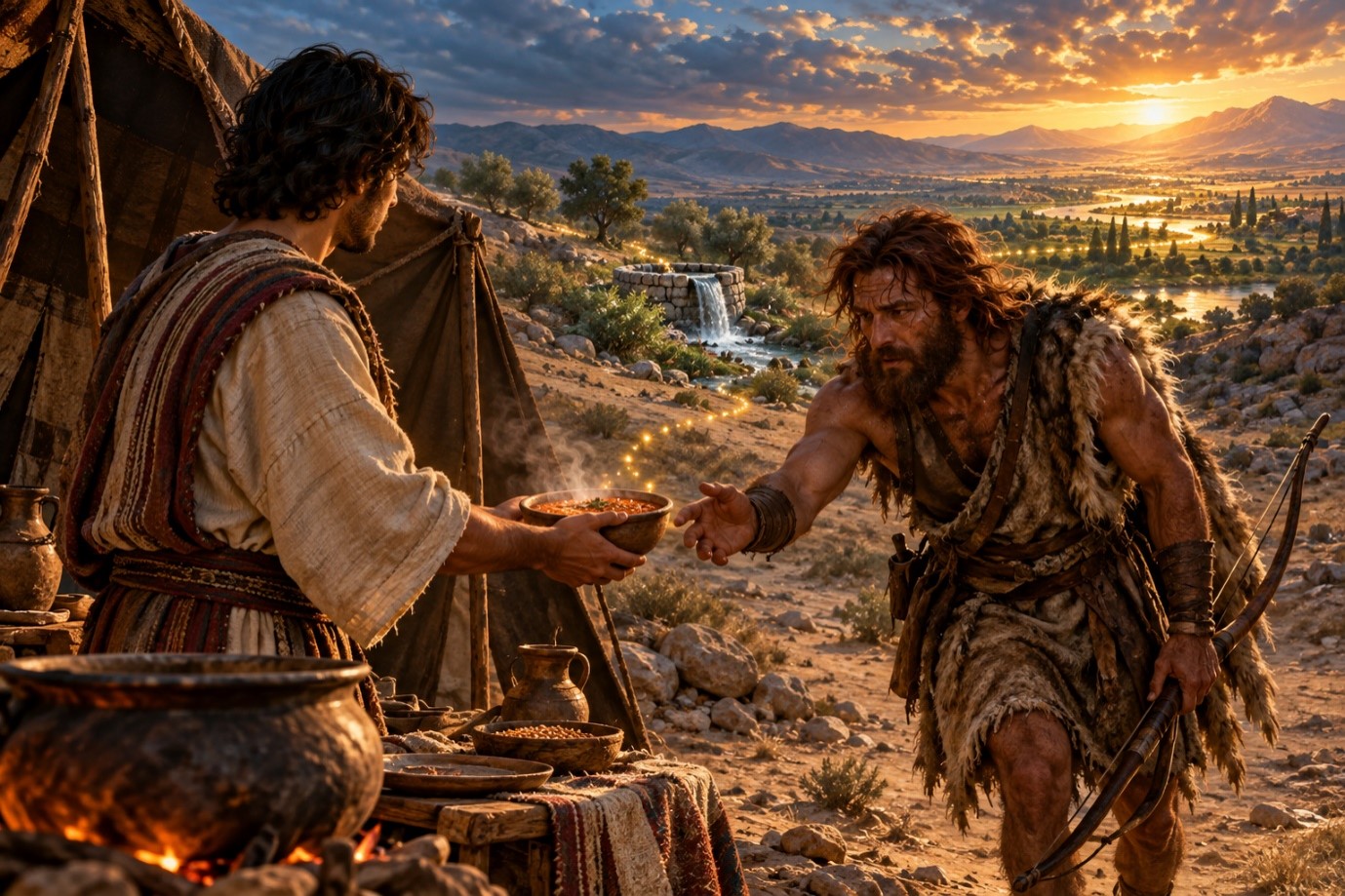
- Esau sells his birthright for a meal.
- Isaac stays in the land during a famine.
- YHVH confirms the Abrahamic covenant to Isaac.
- Isaac reopens Abraham’s wells.
- Conflict arises over the wells.
- Isaac finds room at Rehoboth.
- Abimelech recognises that YHVH is with Isaac.
- Rebekah and Jacob deceive Isaac.
- Jacob receives the covenant blessing.
- Esau weeps over the blessing he has lost.
- Jacob is sent away to find a wife.
- Esau responds by taking another wife.
The parashah is filled with struggle: within Rebekah, between brothers, between shepherds, within a marriage and over the covenant inheritance.
- A Promise Confronted by Barrenness
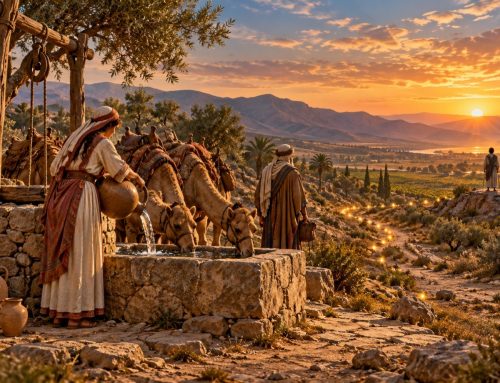
Isaac was the promised son, yet his wife Rebekah was barren for twenty years.
This teaches an important truth: receiving a promise does not mean we will never experience delay, struggle or circumstances that appear to contradict it.
Isaac responds by praying for his wife, and YHVH answers him.
Like Sarah before her, Rebekah’s barrenness makes it clear that the covenant family exists because of YHVH’s faithfulness—not merely through natural human ability.
Each generation must personally learn to trust the One who gave the promise.
- The Struggle Within Rebekah
The children struggle so violently within Rebekah that she asks:
“If all is well, why am I like this?”
Rebekah does something wise: she goes to inquire of YHVH.
YHVH tells her:
- Two nations are in her womb.
- Two peoples will be separated.
- One people will be stronger than the other.
- The older will serve the younger.
The struggle between Jacob and Esau is therefore larger than sibling rivalry. It anticipates the future relationship between Israel and Edom.
YHVH’s choice of the younger son also overturns the normal human expectation that the firstborn must automatically carry the covenant purpose.
- The Eden Connection
The continuing conflict between two seeds
After the fall, YHVH spoke of conflict between the serpent’s seed and the woman’s Seed.
Genesis repeatedly develops this theme through contrasting brothers:
- Cain and Abel
- Ishmael and Isaac
- Esau and Jacob
The issue is not that one person is entirely good and the other entirely evil. Rather, the covenant promise moves through the line YHVH chooses, despite human weakness.
The conflict reminds us that the path back toward Eden will involve a struggle between human rebellion and YHVH’s redemptive purpose.
Appetite and the loss of inheritance
In Eden, forbidden food became the focus of temptation. Adam and Chavah allowed immediate desire to override trust in YHVH’s Word.
Esau repeats this pattern. He exchanges something sacred and lasting for immediate physical satisfaction.
Both accounts ask the same question:
Will we trust YHVH’s Word and value His inheritance, or allow present appetite to rule us?
Blessing, garments and deception
Jacob enters Isaac’s tent wearing Esau’s clothing and the skins of young goats. He receives the blessing while appearing to be someone else.
The scene contains echoes of Eden:
- Food
- Desire
- Deception
- Covering
- Fear
- Blessing and curse
- Broken family relationships
- Departure from home
Humanity continues trying to obtain blessing while hiding behind coverings and deception.
The story demonstrates again that restoration cannot come through human cleverness. We need YHVH to clothe us, transform us and deal truthfully with our hearts.
- Esau and the Birthright
Esau returns from the field exhausted and asks Jacob for food.
Jacob demands the birthright in exchange.
The birthright involved far more than material possessions. In this family it included:
- Responsibility within the covenant household
- Connection with Abraham’s calling
- The promised land
- The continuation of the covenant line
- The privilege of carrying blessing to the nations
Esau says, in effect, that the birthright is of no value to him if it cannot satisfy his immediate hunger.
Genesis concludes:
“Thus Esau despised his birthright.”
His problem was not merely that he was hungry. He treated something sacred as worthless.
Jacob’s desire for the birthright was better than Esau’s contempt for it, but Jacob’s method was manipulative. Valuing the right thing does not justify obtaining it in the wrong way.
- Isaac During the Famine
A famine arises in the land, echoing the famine Abraham experienced.
Isaac appears ready to go toward Egypt, but YHVH tells him to remain in the land.
YHVH confirms the promises given to Abraham:
- His descendants will multiply.
- They will inherit the land.
- All nations will be blessed through his Seed.
Isaac must now trust the promise for himself. He cannot live only on Abraham’s faith.
This is an important generational lesson: we may inherit testimony, teaching and covenant identity, but each generation must personally hear and obey YHVH.
- Isaac Repeats His Father’s Failure
Like Abraham, Isaac fears that he may be killed because of his beautiful wife. He says Rebekah is his sister.
This shows how patterns of fear can pass from one generation to the next.
Isaac inherited Abraham’s covenant blessings, but he also repeated one of Abraham’s failures.
A spiritual inheritance does not automatically remove unhealthy family patterns. Each generation must allow YHVH to confront its fears, habits and deceptions.
Abimelech discovers the truth and rebukes Isaac. Yet YHVH continues to preserve Rebekah and the covenant promise.
YHVH’s faithfulness remains greater than human failure.
- The Wells of Isaac
Isaac prospers greatly, and the Philistines become envious.
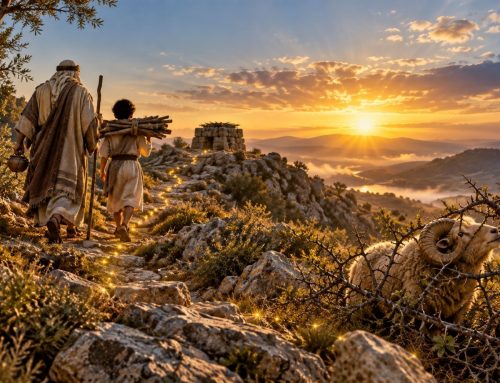
They stop up the wells that Abraham’s servants had dug. Isaac reopens them and restores their original names.
In the ancient world, a well meant:
- Life
- Provision
- Community
- Stability
- The ability to remain in the land
The wells also represent the spiritual inheritance received from the previous generation.
Isaac does not attempt to invent an entirely new covenant story. He uncovers what had been blocked and restores what his father had established.
- Esek, Sitnah and Rehoboth
Isaac’s servants dig and find water, but conflict repeatedly follows.
The wells are named:
- Esek—contention
- Sitnah—opposition or hostility
- Rehoboth—broad places or room
Rather than remaining trapped in constant conflict, Isaac moves on and continues digging.
Eventually he declares:
“For now YHVH has made room for us, and we shall be fruitful in the land.”
Isaac’s restraint is not weakness. He trusts that YHVH can provide another well.
Sometimes faithfulness means defending what matters. At other times, it means refusing unnecessary conflict and trusting YHVH to make room.
- The Prophetic Thread
Jacob and Esau as nations
The prophets later speak about Israel and Edom, the nations descending from Jacob and Esau.
Edom frequently opposes Israel, celebrates Jerusalem’s suffering and refuses brotherly compassion.
Obadiah confronts Edom’s pride and violence. The conflict that began in Rebekah’s womb becomes a picture of the danger of resentment, pride and hostility toward a brother.
“Jacob I loved”
Malachi contrasts YHVH’s covenant relationship with Jacob and His judgment upon Edom.
Paul later quotes this passage in Romans 9 while discussing YHVH’s sovereign covenant purposes.
This language does not mean that Jacob earned YHVH’s love through superior behaviour. Before the twins had done good or evil, YHVH had already declared His purpose.
Election begins with YHVH’s grace and calling—not human merit.
The wells of salvation
Isaiah speaks of drawing water with joy from the wells of salvation.
The physical wells reopened by Isaac form part of a broader biblical theme in which water represents:
- Life
- Cleansing
- The Ruach
- Torah and wisdom
- Salvation
- YHVH’s restoring presence
- The Deception of Isaac
Isaac grows old and his eyesight fades. He prepares to bless Esau.
Rebekah overhears the conversation and arranges for Jacob to receive the blessing.
Each family member contributes to the dysfunction:
- Isaac appears determined to bless Esau despite YHVH’s earlier word.
- Rebekah attempts to secure the promise through deception.
- Jacob cooperates while focusing more on being caught than on whether the plan is right.
- Esau previously despised the birthright but still wants the blessing.
YHVH had already declared that the older would serve the younger. Rebekah and Jacob did not need to manufacture the outcome.
Their deception did not create YHVH’s plan; it brought pain into the way the plan unfolded.
- The Difference Between Birthright and Blessing
The birthright and blessing are connected but not identical.
The birthright concerned covenant responsibility, family leadership and inheritance.
The blessing was a spoken, prophetic declaration concerning fruitfulness, authority and future destiny.
Esau despised the birthright when it seemed inconvenient but later wanted the blessing when its benefits became visible.
This warns us against wanting the rewards of covenant without valuing its responsibilities.
- Jacob’s Covering
Jacob approaches Isaac covered with Esau’s garments and goatskins.
Isaac hears Jacob’s voice but feels what appears to be Esau’s hands.
The tension is captured in his words:
“The voice is Jacob’s voice, but the hands are the hands of Esau.”
Jacob receives the blessing while presenting himself as someone he is not.
This points to humanity’s larger problem: we often hide our true condition and attempt to gain acceptance through an outward covering.
Later in Jacob’s life, YHVH will confront his identity directly. Jacob will have to answer honestly to his own name before receiving a transformed name.
YHVH’s purpose is not merely to give Jacob a blessing. It is to change Jacob himself.
- Esau’s Tears
When Esau discovers what has happened, he cries with a great and bitter cry.
His grief is real. Yet Hebrews warns that Esau found no opportunity to reverse what had occurred, though he sought the blessing with tears.
Tears alone are not necessarily repentance. We can be deeply sorry about consequences without experiencing a genuine change of heart.
Esau’s earlier contempt for the birthright had revealed what he valued. His later tears focused primarily on the blessing he had lost.
The account asks whether we value YHVH Himself and His covenant—or merely the benefits we hope to receive.
- The New Testament Connection
The children of promise
Paul refers to Isaac as the child of promise. The covenant line exists because YHVH acts according to His Word.
Jacob’s selection before birth further demonstrates that YHVH’s redemptive purpose is grounded in grace rather than human achievement.
This does not excuse Jacob’s deception. It means that even human sin cannot overthrow YHVH’s covenant plan.
Esau and temporary appetite
Hebrews describes Esau as profane because he sold his birthright for one meal.
The warning applies to anyone who trades eternal inheritance for temporary satisfaction.
Yeshua asks:
“What will it profit a person if he gains the whole world and loses his soul?”
Esau lost sight of future value because present hunger felt more urgent.
Yeshua the faithful Firstborn
Where Esau failed to value his birthright and Jacob tried to obtain blessing through deception, Yeshua is the faithful Firstborn.
He:
- Values the Father’s will above physical appetite.
- Resists temptation in the wilderness.
- Does not seize authority through deception.
- Obeys even through suffering.
- Receives the nations as His rightful inheritance.
- Shares His inheritance with those united to Him.
Yeshua does not disguise Himself to steal another’s blessing. He takes our sin and shame upon Himself and shares His own righteousness and inheritance with us.
Living water
Isaac’s wells point toward the biblical promise of living water.
Yeshua offers living water that satisfies the deepest thirst. John explains that He was speaking of the Ruach whom believers would receive.
The stopped wells remind us that sources of spiritual life can become neglected or blocked. Through repentance and renewed obedience, YHVH calls His people back to the life found in His Word and Ruach.
- The Breadcrumbs Through Scripture
| Toldot | New Testament connection | Final restoration |
| Rebekah receives life after barrenness | The covenant family exists by promise | Creation becomes fruitful again |
| Two sons struggle in the womb | Flesh and Spirit remain in conflict | Rebellion is finally removed |
| Esau exchanges his birthright for food | Believers are warned not to trade eternal inheritance for temporary desire | YHVH’s people receive an imperishable inheritance |
| Isaac remains in the promised land | Believers live by faith in YHVH’s promise | The renewed earth becomes their inheritance |
| Isaac reopens the wells | Yeshua gives living water through the Ruach | The river of life flows from YHVH’s throne |
| Jacob hides beneath another’s garments | Humanity attempts to cover its true condition | YHVH’s people are clothed in righteousness |
| The blessing produces family division | Human deception wounds relationships | Yeshua brings reconciliation and truth |
| Jacob receives the covenant blessing | The promised Seed comes through Israel | All nations are blessed through Yeshua |
Key Thought
Esau traded an eternal inheritance for an immediate appetite, while Jacob valued the inheritance but tried to obtain it through deception. Both brothers reveal humanity’s need for Yeshua—the faithful Firstborn who values the Father’s will, walks in truth and shares His inheritance with those who belong to Him.

- Toldot: Do Not Trade the Promise for a Bowl of Stew November 7, 2026Central message: Toldot follows the covenant promise into the next generation. Isaac and Rebekah face barrenness, their sons struggle before birth, Esau despises his birthright, and Jacob seeks the blessing through deception. The parashah reveals YHVH’s sovereign purpose, the value of covenant inheritance and the painful consequences of trying to obtain through human schemes […]
- Chayei Sarah: A Bride, a Promise and Life Beyond the Grave November 2, 2026Central message: Chayei Sarah begins with death, but it is filled with signs of continuing life. Sarah is buried in the promised land, a bride is found for Isaac, and the covenant moves into the next generation. YHVH’s promises continue even when faithful people die. The Original Setting Chayei Sarah means “The Life […]
- Vayera: The Promised Son and the Elohim Who Provides October 25, 2026Central message in Vayera: YHVH reveals Himself as the One who sees, visits, judges, shows mercy and fulfills what appears impossible. The promised son is born, Abraham intercedes for the wicked, and on Mount Moriah YHVH provides a substitute—leaving powerful breadcrumbs that lead toward Yeshua. The Original Setting Vayera means “And He appeared.” […]
- Lech Lecha: Following the Call Back to the Promise October 17, 2026Central message: YHVH calls Abram out of his familiar world and leads him toward an unseen promise. Through Abram’s faith journey, YHVH begins reversing the scattering, curse and separation introduced in the opening chapters of Genesis. His purpose is not merely to bless one man, but to bring blessing to all the families of […]
- Noach: Through the Waters Toward Restoration October 10, 2026Central message: YHVH judges a world filled with violence, preserves life through Noach, and renews His covenant purpose. Yet the flood changes the world without changing the human heart. Humanity still needs more than another beginning—it needs inward renewal through Yeshua. The Original Setting Parashat Noach contains three major movements: The flood: Creation […]
- B’reisheet: From Darkness to Eden October 5, 2026B’reisheet introduces the great storyline of Scripture: Elohim creates a good world, humanity is called to bear His image, sin brings exile and death, yet YHVH immediately begins revealing His plan of redemption and restoration through Yeshua. The Original Setting B’reisheet contains several foundational events: Elohim creates the heavens and the earth. Light […]
- The Oath That Made a People : Nitzavim September 17, 2026A commentary on Parashah Nitzavim (Deuteronomy 29:9–30:20) Scripture quotations are from the American Standard Version (1901). Verse numbers in Deuteronomy follow the Hebrew text; English Bibles run one verse higher in this section. 1. Standing in a covenant that was sworn before you were born Nitzavim opens with Israel standing — nitzavim — […]
- Ha’azinu: Luister na die Lied van die Rots September 17, 2026Die naam Ha’azinu beteken “Luister!” Hierdie Torahgedeelte, Deuteronomium 32, bevat die lied wat Moses kort voor sy dood aan Israel geleer het. Dit herinner die volk aan YHVH se trou, waarsku hulle teen geestelike afvalligheid en eindig met die hoop op herstel en versoening. Moses begin deur sy woorde met reën en dou […]
- STAAN, KIES EN WANDEL : NITZAVIM – VAYELECH August 29, 2026Nitzavim–Vayelech : Deuteronomium 29:10–31:30 Hierdie week lees ons ’n dubbele Torah-gedeelte, Nitzavim en Vayelech, en saam bring hierdie twee gedeeltes ons by een van die aangrypendste oomblikke in die Torah. In Nitzavim–Vayelech staan Israel op die vlaktes van Moab. Die woestynreis is amper verby. Die Beloofde Land lê voor hulle. Moses weet dat […]
- WANNEER JY INKOM – KI TAVO August 24, 2026DIE KERN BOODSKAPPE VAN KI TAVO: Onthou waaruit YHVH jou gebring het, wees dankbaar vir waar Hy jou gebring het, en wanneer jy Sy seën binnestap, moenie die Gewer vergeet nie. Ki Tavo (כִּי־תָבוֹא) beteken “Wanneer jy inkom.” Israel staan op die punt om die Beloofde Land binne te gaan. Ná jare in […]