Like seeds hidden beneath the earth, the chapter artfully shifts the story from a feeling of emptiness to one of provision, a change that occurs with remarkable quietness.
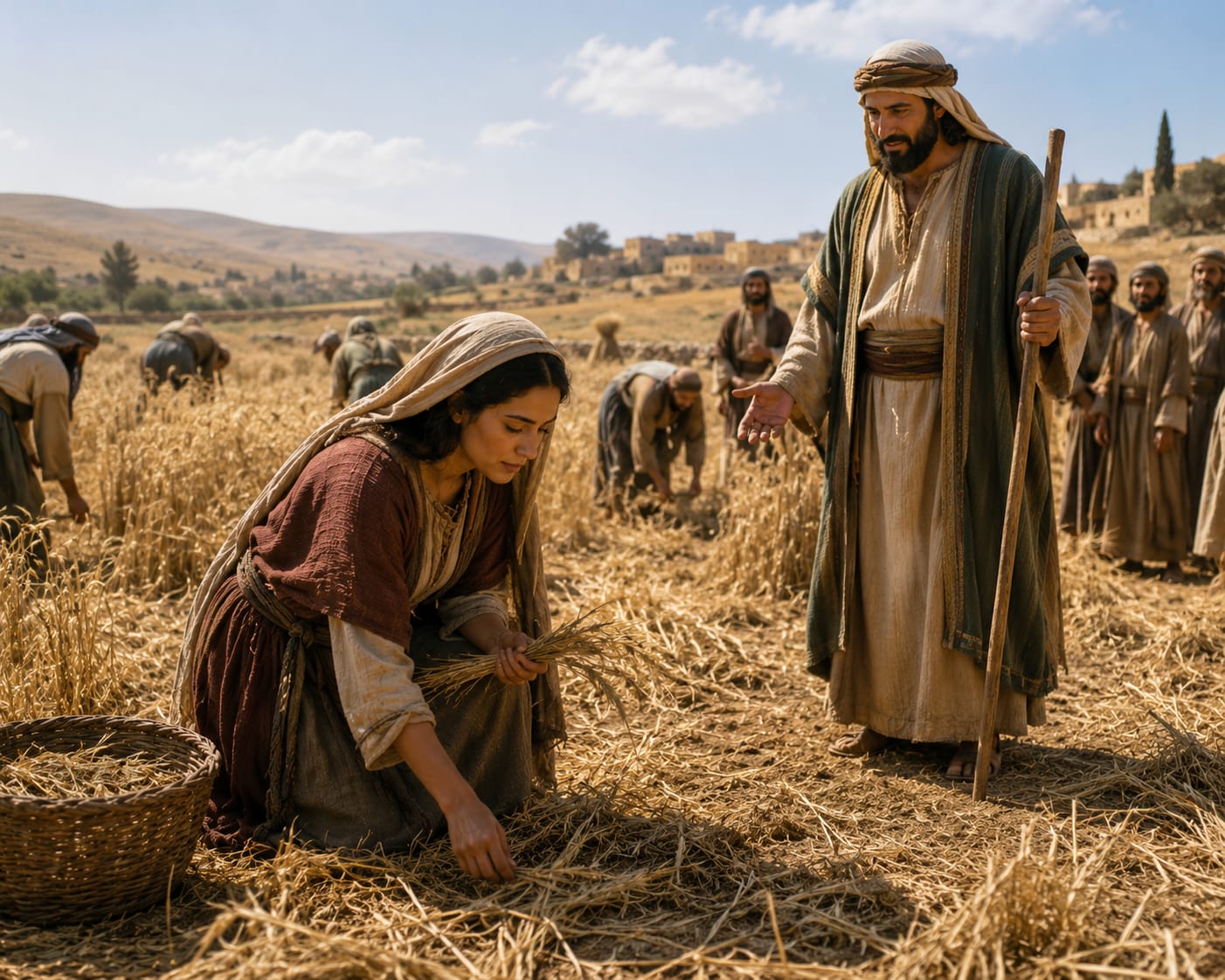
Ruth goes to the fields to collect what’s left, fulfilling the role of the poor and the foreigner. It appears to be a fortunate coincidence that she is found in Boaz’s land, a man of repute, principle, and compassion. However, in the language of Scripture, this is intentional. It is the hidden choreography of redemption.
Boaz perceives Ruth’s character, not merely her hard work. He knows of her loyalty to Naomi and her decision to take refuge under the wings of the Elohim of Israel. Rather than viewing her as an outsider, he extends a warm welcome, offers protection, and provides lavishly for her needs.
He tells his workers to leave extra grain behind.
This is not mere generosity—it is grace.
Ruth came to gather scraps, but she leaves with abundance. An outsider, yet she is treated with honor. In this moment, Boaz becomes a living picture of the Messiah:
- He notices the unseen
- He covers the vulnerable
- He provides beyond expectation
Ruth’s posture is just as powerful. She receives modestly without making demands. She bows low and asks, “Why have I found favor?” The essence of those who draw near to Father is reflected in her life; it’s characterized by gratitude, not by a sense of entitlement.
This chapter foreshadows the Messianic promise. We find refuge in Yeshua, much like Ruth found refuge in Boaz’s field. We arrive with nothing to offer, but we are invited to join in a field of grace.
Ruth 2 reminds us:
- Father guides even our smallest steps
- Grace meets us in ordinary places
- The Redeemer sees and provides
What looks like coincidence is often divine appointment.
And in the fields of provision, the Elohim of Israel is already writing a story of redemption—one handful at a time

- Walking in the Footsteps of Covenant – Ekev July 27, 2026The Hebrew word Ekev (עקב) literally means heel or because. It carries the beautiful picture of following in someone's footsteps. Just as a heel leaves a footprint behind, Israel was called to walk in the footsteps of YHVH's covenant. The blessings described in this parashah were not random rewards, but the natural fruit of […]
- The Heart That Hears : Va’etchanan July 20, 2026The name Va'etchanan, meaning "I pleaded" or "I earnestly sought favor," reflects Moses' heartfelt plea to YHVH from the plains of Moab, begging to enter the Promised Land. Despite Elohim's loving refusal, Moses, rather than dwelling on his disappointment, dedicates his final days to preparing the Israelites for a future he will not witness. […]
- From Tears to Hope : The month of Av July 16, 2026The month of Av is one of the most significant months on the biblical calendar. At first glance it seems to be marked by sorrow, yet beneath its ashes lies a remarkable promise of restoration. Historically, the Ninth of Av (Tisha B'Av) became a day associated with national tragedy. Jewish tradition remembers that […]
- Remember the Road, Prepare for the Promise (Devarim) July 15, 2026As the book of Devarim (Deuteronomy) begins, Israel stands on the eastern side of the Jordan River. The wilderness journey is nearly complete. A new generation is poised to enter the Promised Land, but before crossing over, Moses pauses. Instead of delivering military orders, he starts with a sermon. Before Israel can claim […]
- Mattot : Faithful Words, Faithful Hearts July 7, 2026Parashat Mattot poses three timeless questions: Are our words trustworthy? Are we removing compromise from our lives? Are we committed to the wellbeing of Father’s people as much as our own family? The portion of Mattot begins with instructions about vows and oaths. In a world where words can be spoken lightly and […]
- Pinchas: Zeal that Brings Life June 28, 2026Parashat Pinchas opens in the wake of a somber chapter in Israel's history. The people had succumbed to idolatry and immorality at Baal Peor, inviting divine judgment upon the camp. Amidst this crisis, Pinchas demonstrated zealous devotion to the holiness of YHVH, and his actions averted Elohim's anger. Consequently, he was granted a "covenant […]
- Prophetic images of hope : Pictures of Messiah in Chukat June 23, 2026Parashat Chukat, Numbers 19:1-22:1, contains some of the most mysterious passages in the Torah : The accounts of the water from the Rock, the Red Heifer and the bronze Serpent beautifully bridge the Torah and the Good News, showing that even in the wilderness YHVH was already revealing His plan of redemption through Messiah […]
- Korach : The Subtle Seed of Rebellion June 14, 2026Parashat Korach (Numbers 16-18) is far more than the story of a man who challenged Moses. It is a warning about the subtle seed of rebellion that can grow in any heart. Korach was a Levite, chosen for a sacred calling, yet he became dissatisfied with the role YHVH had given him. Under […]
- From Fear to Faith: Learning from the Spies June 9, 2026Parashat Sh’lach (Numbers 13–15) tells the dramatic story of the twelve spies sent to explore the Promised Land. All twelve saw the same land flowing with milk and honey. All twelve carried the same giant cluster of grapes back to Israel. Yet only two, Joshua and Caleb, returned with faith. The other ten […]
- The Tongue: From Fire to Restoration May 31, 2026Last week, in Nosa (Numbers 4:21-7:89), we discussed the priestly blessing as a model of restoration, where people are lifted up and blessed. This week, in Beha'alotcha (Numbers 8:1-12:16), we see a practical illustration of this in the lives of Moses and Miriam. James 3:5-10 paints a vivid and unsettling picture of the […]