In this week’s Torah portion, Vayechi, (and he lived) we reach the end of the stories of the patriarchs. In the last 2 chapters of Genesis we read about the blessings of the sons of Israel, the death and funeral of Jacob/Israel, followed by the death of Josef.
Jacob only lived in Egypt for a short period, but those 17 years seemed to have been some of the best years of his life — years of prosperity, goodness, and peace. He was reconciled with his lost son, and the brothers lived together in peace. The family lacked nothing and grew in numbers. The previous 130 years of his life were filled with hard work and pain, almost as the saying goes: blood, sweat and tears.
Most of Jacob’s life was a “struggle”. It started with a struggle in the womb even before his birth. Growing up with his brother Esau, presented a fair number of struggles. In the next chapters we read about the favouritism of the parents towards their children, causing even more struggle in the life and family of Jacob.
Deception was the only way his mother, Rivkah, seemed to know in her attempt to counter the father’s favouritism. Jacob was drawn into the plot of deception and would reap the harvest of the wrong decision for years to come.
We saw deception where Rivkah and Jacob deceived Isaac. Where Laban deceived Jacob by giving him Lia as bride instead of Rachel. Where Simeon and Levi deceive and kill the whole male population at Shechem. Where Joseph is sold by his brothers and later with Joseph, where he hides his identity. This is but to name a few.
Favouritism does not stop at Jacob and Esau, it almost consumes Jacob’s life and where deception stops, favouritism does not end. He favoured his one wife; he favoured 2 sons. This led to hatred, feuds and sorrows in his family.
Hardship and sorrow were also no strangers to him. His beloved wife Rachel was barren. His daughter Dinah was abducted and raped. Two of his sons, Simeon and Levi, murdered all the men of a city. His other sons robbed the city in mourning, and enslaved all the women and children. Maybe the worst for him was that he believed that his beloved son Joseph was killed.
Although his life was filled with incidents of deception, being referred to as ‘the deceiver’ seems wrong to me, as he was deceived more than he deceived. Even after his name was changed from Jacob to Israel, the deception and favouritism in his family did not stop, but he was not part of it anymore. He was respected by the neighbouring countries and tribes. He was not without faults, but a man of principle and a man of peace (Gen 34:21,30).
It is easy for most of us to find a time or incident in Jacob’s life that we can identify with. He had times of great success, but also of massive failure. To see your sheep-herd grow despite all the odds being against you. To see your family grow despite the barenness of your beloved wife. Who would not love to have had a one-on-one encounter with our Heavenly Father? Even if it cripples you. To have been chosen as the image bearer of our Creator, to portray the character of our loving Father, not just to your family, but to all nations around you. It seems to me (if you look at the illustriousness of his funeral) that Jacob did that with remarkable success.
After his death in Egypt, not just his family, but the entire Egyptian nation mourned his death. He was more than just the father of Joseph. He was also a man of peace that Egypt learned to respect. Jacob was respected as an ambassador of the Kingdom. His death led to more than just a big funeral, it was huge. And he managed to display our Father’s character without compromise.
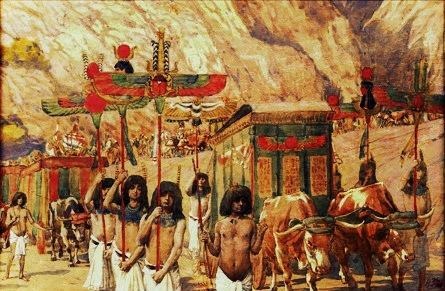
They did not merely transport his remains to Israel, as he requested. He was honoured with a true Egyptian Royal funeral, even embalmed like the royalty of Egypt.
It was not only Joseph who received permission from the Pharoah for him and his family to go and bury his father. The servants of Pharaoh and the elders of his house and all the elders of the land of Egypt, and all the house of Joseph and his brothers and his father’s house, all joined in the journey to Israel.
I can just imagine the procession, the masses of mourners that came to show their last respects to the father of Joseph. Later we read about the death of Joseph, he did not have a funeral that could compare to this one at all and he was considered as the one that saved the world from starvation.
The funeral lasted a full 4 months. If I look at it as more or less 120 days, it helps me to see the period more clearly.
It was more than just people walking in a procession behind a coffin. He was mourned. As a matter of fact, the mourning over Jacob was so great that the Canaanites renamed the place of mourning to Abel-mizraim (Meadow of Egypt). (Gen 50:10-11)
This made me think, am I a true ambassador of the Kingdom. Do I impact the lives of the “nations” around me with His love, grace, mercy and peace? Will the people around me mourn me and miss me and the impact I had in their lives, or will they be glad when I am gone? Do I draw others to my Creator, Father, and King by displaying His character or do I push them away with criticism, hate and pride?
I would like to leave you with a thought from Rashi: A kindness done to the dead is a true kindness, for one does not expect a favour in return.
All to the Glory of our Father!

- Mattot : Faithful Words, Faithful Hearts July 7, 2026Parashat Mattot poses three timeless questions: Are our words trustworthy? Are we removing compromise from our lives? Are we committed to the wellbeing of Father’s people as much as our own family? The portion of Mattot begins with instructions about vows and oaths. In a world where words can be spoken lightly and […]
- Pinchas: Zeal that Brings Life June 28, 2026Parashat Pinchas opens in the wake of a somber chapter in Israel's history. The people had succumbed to idolatry and immorality at Baal Peor, inviting divine judgment upon the camp. Amidst this crisis, Pinchas demonstrated zealous devotion to the holiness of YHVH, and his actions averted Elohim's anger. Consequently, he was granted a "covenant […]
- Prophetic images of hope : Pictures of Messiah in Chukat June 23, 2026Parashat Chukat, Numbers 19:1-22:1, contains some of the most mysterious passages in the Torah : The accounts of the water from the Rock, the Red Heifer and the bronze Serpent beautifully bridge the Torah and the Good News, showing that even in the wilderness YHVH was already revealing His plan of redemption through Messiah […]
- Korach : The Subtle Seed of Rebellion June 14, 2026Parashat Korach (Numbers 16-18) is far more than the story of a man who challenged Moses. It is a warning about the subtle seed of rebellion that can grow in any heart. Korach was a Levite, chosen for a sacred calling, yet he became dissatisfied with the role YHVH had given him. Under […]
- From Fear to Faith: Learning from the Spies June 9, 2026Parashat Sh’lach (Numbers 13–15) tells the dramatic story of the twelve spies sent to explore the Promised Land. All twelve saw the same land flowing with milk and honey. All twelve carried the same giant cluster of grapes back to Israel. Yet only two, Joshua and Caleb, returned with faith. The other ten […]
- The Tongue: From Fire to Restoration May 31, 2026Last week, in Nosa (Numbers 4:21-7:89), we discussed the priestly blessing as a model of restoration, where people are lifted up and blessed. This week, in Beha'alotcha (Numbers 8:1-12:16), we see a practical illustration of this in the lives of Moses and Miriam. James 3:5-10 paints a vivid and unsettling picture of the […]
- Heaven’s Voice, Echoed on Earth May 26, 2026Comparing the Priestly blessing in Numbers 6:24-26 with the Lord’s prayer in Matthew 6:9-13, we find a beautiful symmetry in Scripture, like and echo reflecting back. One is spoken over the people, the other through the people, yet both flow from the same divine heart. The Priestly Blessing begins, “יהוה bless you and […]
- Ruth 4: The Redeemer at the Gate — A Messianic Reflection May 19, 2026Ruth 4 brings the story to the city gate—the place of decision, witness, and redemption. What has been unfolding in quiet fields now steps into the light. Boaz meets the nearer kinsman-redeemer before the elders. The right to redeem Naomi’s land is offered, but when the cost becomes clear—marrying Ruth and raising up […]
- Ruth 3: At the Threshing Floor May 19, 2026The chapter unfolds in the stillness of night, on a threshing floor where grain is separated and hearts are laid bare. What began in famine is now progressing toward redemption—but not without intention, courage, and trust. Naomi tells Ruth to approach Boaz, the kinsman-redeemer, and make a bold request. Ruth humbly goes to […]
- Ruth 2 : Grace in the field May 19, 2026Like seeds hidden beneath the earth, the chapter artfully shifts the story from a feeling of emptiness to one of provision, a change that occurs with remarkable quietness. Ruth goes to the fields to collect what's left, fulfilling the role of the poor and the foreigner. It appears to be a fortunate coincidence […]