This week’s Torah portion (Vayigash) is all about reuniting lost family members, healing of division in families, reconciliation, and forgiveness. Amid this Joseph narrative, we get a glimpse of Benjamin, the younger brother of Joseph.
We were first introduced to Benjamin where we read about his birth in Gen 35:17-18. From the first mention there are contrasts. Death and life at his birth, his mother died as he was born. His mother wanted to name him son of my sorrow, but his father named him son of my right hand. The history of Benjamin and his descendants is filled with contrasts between death and triumph.
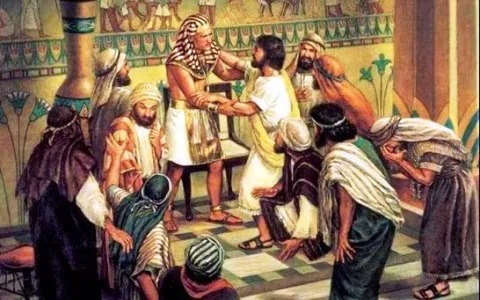
This week Benjamin plays a key role, without any dialogue from him. No words from Benjamin are recorded , only the emotion in Gen 45:14, when he cried after being reunited with Joseph.
Benjamin played a mayor roll in the reconciliation and restoration process of the brothers. By falsely blaming him of theft, Joseph could see that the brothers truly changed. This proof of remorse lead to true forgiveness and eventually to the restoration of relationships.
Next week we will read about the blessings of a loving Father bestowed upon his beloved sons. The verse with the blessing of Benjamin caused me to read it again, can this really be how Jacob felt about Benjamin? Comparing his beloved son to a wolf? I doubt it, I personally think that Jacob gave the blessing exactly as he received it from God, without watering it down or basting it with honey. Jacob did this without questioning God and without mixing it with his own emotions. Am I capable of this?
We read: Gen 49:27 “Binyamin is a wolf that tears, in the morning he eats prey, and at night he divides the spoil.” Looking at this, the contrast jumps out at me again. From creation days are evening followed by morning, but not here. Looking at the time of creation, we see that days start at evening and are followed by morning, but here we have time in reverse order.
Why do I think the blessing was prophetic? Let us briefly look at some of the history of the descendants of Benjamin as recorded in the Bible. Let us explore the transition from light to darkness as mentioned in the prophecy. And then turning around from darkness back to light. There is always hope and a way back to our Creator.
Benjamin himself had no dark side mentioned. He never argued with his father about the decision to let him go down to Egypt. He never once argued with his brothers. It seemed that the whole family loved him and wanted to protect him. He did not argue when his bag was searched, and the cup found in it. He did not resist when taken back to the court in Egypt. He was not a wolf at all. The warlike character of a wolf that is described in Scripture (Jer 5:6; Zeph 3:3; Eze 22:27) is not displayed in the life of Benjamin. His life, in itself, is in contrast with the picture painted in the blessing.
In Judges 3:12-30 we are introduced to Ehud, a Benjamite, a great and fierce warrior who delivered Israel from the Moabites. It is specifically mentioned that he is lefthanded in verse 15. Do you also see the contrast in the words? Descendent of the son of his right hand, Ehud, the left-handed warrior.
In Judges 19-21 there is another war, but this time the Benjamites are not the heroes, delivering the nation. We are introduced to the darker side of the Benjamites . The Benjamites act a lot like the men from Sodom and Gomorrah. The horrific abuse and death of an unnamed Levite’s concubine caused a civil war when the other 11 tribes declared war against the tribe of Benjamin.
Judges 21:25 reads : In those days there was no sovereign in Yisra’ĕl – everyone did what was right in his own eyes. At first the other 11 tribes suffered great losses against the fierce warriors of Benjamin. But once they started acting in unity, it all changed, and the tribe of Benjamin was almost annihilated. After the war all 12 tribes, including the tribe of Benjamin, were united. With the help of the other tribes, Benjamin was restored and repopulated.
Then there was the first King of Israel, Saul, the Benjamite. The king chosen to unite the scattered tribes of Israel and to lead them to victory over their enemies. Before his kingship, Israel was led by judges who helped with guidance and resolving disputes. Judges could however not lead the nation during times of war. There was a constant threat of war from the Philistines and the people “forced” Samuel to appoint a king, to lead them to victory.
Saul came from a wealthy family and the Bible describe him as tall, dark, and handsome. (1Sam 9:2) He started his reign in peace, but the competent military leader then led Israel in a series of victories. His popularity grew with every victory and led to him being proclaimed king for a second time (1 Sam 11:1-15). But the glorious time faded as a dark cloud moved in. It started with an unauthorised sacrifice (1Sam13 9-14) and from there it went downhill. He was commanded to kill all the Amalekites and their livestock, but spared king Agag and the choice livestock (1 Sam 15). He actually lied to God when he lied to Samuel. This led to one of the saddest events in Scripture, when God eventually withdrew His Spirit from Saul (1 Sam 16:14). Saul was plagued by a evil spirit during the rest of his reign. Clearly this Benjamite went from light to darkness as in the prophecy.
Esther, the cousin of Mordecai the Benjamite, needs no introduction. We are introduced to her during a very dark time in the history of Israel. Through her the tribe of Benjamin had an opportunity to correct the wrong of king Saul. It was Haman, the Amalekite, descendant of Agag, who tried to do to Israel what Saul was supposed to do to the Amalekites in 1 Sam 15. Saul was supposed to kill them all. Yet another clear contrast. The Benjamites had a chance to be obedient to the voice of our Creator and this led to victory over Amalek. A clear movement from darkness to light is visible, and a nation is restored and reconciled with the land as they returned from captivity.
And finally, we find another Saul, the Benjamite in the New Testament. We see him starting off as a pharisee, referring to himself as a pharisee, son of a pharisee (Acts23:6). His dark side is very evident to us when he becomes the greatest persecutor of the followers of Yeshua that is recorded in Scripture. (Acts 8:1-3) But eventually he saw the light and became, not only a follower of Yeshua, but the greatest advocate for our Master amongst the nations.
Contrast again in the life of 2 Benjamites named Saul : Where king Saul moved from light to darkness, we have Saul from Tarsus moving from darkness to light.
I hope this short journey through the history of the Benjamites helped you to see why I see his blessing as a prophetic picture. A blessing that at first glance sounds like a curse, is actually carrying a message of hope in history.
Lessons I learned from Benjamin :
- Our Creator doesn’t see as men see, for He looks at our hearts.
- He can use man for His glory in the reconciliation and restoration process, even when our lives do not display His image or presence.
- And through the Amalek in the lives of king Saul and queen Esther we see that He always gives us a chance to correct our wrongs.
Benjamin is fully restored and we read that he is one of the 12 tribes that total the 144 000 in Revelation.
While studying Benjamin, I cannot miss the current prominent “Benjamin” in Israel : Benjamin Netanyahu. The meaning of “Netanyahu” is “God has given.”
Do we see another type of king Saul? A man chosen by the people but permitted to rule by our Creator in times when Israel is surrounded by enemies. Will his rule be followed by a Kingly rule from Jerusalem in peace, by a type of King David for maybe 1000 years? We will have to wait and see, for now we can only speculate.
All to the Glory of our Father!

- The Oath That Made a People : Nitzavim September 17, 2026A commentary on Parashah Nitzavim (Deuteronomy 29:9–30:20) Scripture quotations are from the American Standard Version (1901). Verse numbers in Deuteronomy follow the Hebrew text; English Bibles run one verse higher in this section. 1. Standing in a covenant that was sworn before you were born Nitzavim opens with Israel standing — nitzavim — […]
- Ha’azinu: Luister na die Lied van die Rots September 17, 2026Die naam Ha’azinu beteken “Luister!” Hierdie Torahgedeelte, Deuteronomium 32, bevat die lied wat Moses kort voor sy dood aan Israel geleer het. Dit herinner die volk aan YHVH se trou, waarsku hulle teen geestelike afvalligheid en eindig met die hoop op herstel en versoening. Moses begin deur sy woorde met reën en dou […]
- STAAN, KIES EN WANDEL : NITZAVIM – VAYELECH August 29, 2026Nitzavim–Vayelech : Deuteronomium 29:10–31:30 Hierdie week lees ons ’n dubbele Torah-gedeelte, Nitzavim en Vayelech, en saam bring hierdie twee gedeeltes ons by een van die aangrypendste oomblikke in die Torah. In Nitzavim–Vayelech staan Israel op die vlaktes van Moab. Die woestynreis is amper verby. Die Beloofde Land lê voor hulle. Moses weet dat […]
- WANNEER JY INKOM – KI TAVO August 24, 2026DIE KERN BOODSKAPPE VAN KI TAVO: Onthou waaruit YHVH jou gebring het, wees dankbaar vir waar Hy jou gebring het, en wanneer jy Sy seën binnestap, moenie die Gewer vergeet nie. Ki Tavo (כִּי־תָבוֹא) beteken “Wanneer jy inkom.” Israel staan op die punt om die Beloofde Land binne te gaan. Ná jare in […]
- WANNEER GELOOF DEEL WORD VAN JOU ALLEDAAGSE LEWE – KI TETZE August 16, 2026Ki Tetze (כִּי־תֵצֵא) beteken “Wanneer jy uittrek” of “Wanneer jy uitgaan.” Hierdie Torah-gedeelte bevat meer gebooie as enige ander porsie en raak ’n verstommende verskeidenheid aspekte van die alledaagse lewe aan: gesinsverhoudings, die huwelik, werk, geregtigheid, die versorging van kwesbares, eerlikheid in besigheid, goedheid teenoor diere en selfs die terugbesorging van iets wat verlore […]
- SHOFTIM – WIE REGEER MY HART? August 11, 2026Die woorde waarmee hierdie gedeelte begin, bly deur die eeue heen weerklink: “Geregtigheid, geregtigheid moet jy najaag.” Deuteronomium 16:20 Shoftim (שֹׁפְטִים) beteken “regters”. Israel staan op die drumpel van die Beloofde Land, en YHVH leer hulle dat dit nie genoeg is om die land bloot in besit te neem nie. Hulle moet daarin […]
- Kies Lewe deur die Koning te Volg – Parasha Re’eh August 5, 2026"Kyk (Re'eh), Ek hou vandag voor julle die seën en die vloek." (Deut 11:26) Die eerste woord van hierdie week se Parasha is Re'eh, wat beteken "Kyk!" Dit is merkwaardig dat Moses die volk in die enkelvoud aanspreek. Al staan die hele volk voor hom, spreek hy elke persoon individueel aan. Elkeen moes […]
- Walking in the Footsteps of Covenant – Ekev July 27, 2026The Hebrew word Ekev (עקב) literally means heel or because. It carries the beautiful picture of following in someone's footsteps. Just as a heel leaves a footprint behind, Israel was called to walk in the footsteps of YHVH's covenant. The blessings described in this parashah were not random rewards, but the natural fruit of […]
- The Heart That Hears : Va’etchanan July 20, 2026The name Va'etchanan, meaning "I pleaded" or "I earnestly sought favor," reflects Moses' heartfelt plea to YHVH from the plains of Moab, begging to enter the Promised Land. Despite Elohim's loving refusal, Moses, rather than dwelling on his disappointment, dedicates his final days to preparing the Israelites for a future he will not witness. […]
- From Tears to Hope : The month of Av July 16, 2026The month of Av is one of the most significant months on the biblical calendar. At first glance it seems to be marked by sorrow, yet beneath its ashes lies a remarkable promise of restoration. Historically, the Ninth of Av (Tisha B'Av) became a day associated with national tragedy. Jewish tradition remembers that […]