This week, in the Torah portion Shemot, we are introduced to Moses, the main character in the next four books of the Bible. Moses was a normal human being, a man that escaped death more than once to be transformed to a hero, a leader and, above all, a man that spoke to our Father face to face, and yet Moses is described as the most humble of all men.
In Shemot / Exodus , our first encounter is with Moses as a beautiful baby boy (Ex 2:2). He was so pretty that his mother decided to hide him in the hope to keep and raise him. Can you imagine the heartbreak and fear she experienced when she realised that she could no longer hide him? What came from his mouth in the form of laughter, baby babbling and crying, was what endangered his life and led to his first transformation.
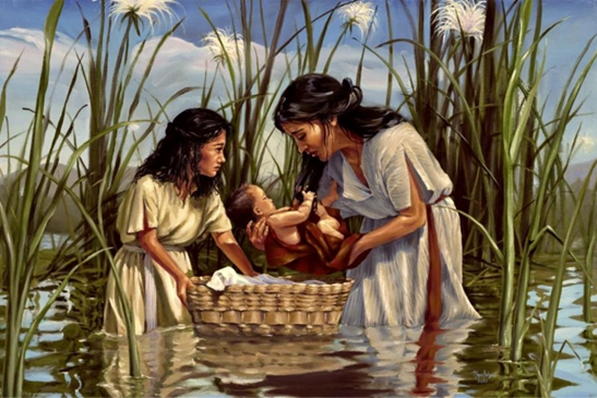
A strange thing then happened: Moses’ mother made a basket and painted it with slime and pitch. Then she put baby Moses into the basket and placed it amongst the reeds at the edge of the river. He was floating in his own little ark on the same river in which many other baby boys died. Meanwhile his sister kept a watchful eye on him.
Lo and behold, Pharaoh’s daughter saw (H7200) the basket and sent her female servant to fetch it. Inside was a beautiful, crying, circumcised baby boy, clearly a Hebrew. She decided to save his life and raise him as her own. In his first transformation, Moses was therefore transformed from a Hebrew slave boy to an Egyptian prince, the son of an Egyptian princess.
Many years later, as a grown prince of Egypt, Moses went out to see (H7200) what work his Egyptian brothers did. There he saw (H7200) an Egyptian striking a Hebrew slave. A change took place in Moses’ heart, mind and actions. He could not tolerate the oppression and hatred, the obvious bullying of the “weak” – he had compassion for the oppressed. He looked around and when he saw (H7200) that nobody was looking, Moses killed the Egyptian. This led to his second transformation, because when later trying to break up a fight between two Hebrews, witnesses of the first incident referred to Moses killing the Egyptian. As a result, Moses had to flee, for Pharaoh had sent his guards to kill him. In his second transformation Moses was transformed from prince of Egypt to an Egyptian fugitive.
He fled to Midian and at a well he saw bullying again. This time it was men bullying the “weak” – the daughters of a priest. Again, Moses intervened on behalf of the oppressed, this time with the opposite action and reaction. He did not show aggression or anger, but only compassion for the “weak”. He did not even confront the culprits, but instead just helped the daughters to water their sheep after the water they drew for their sheep water was taken. Moses had changed and that caused the shepherdesses to react differently from the Hebrews. The shepherdesses took him in and made him part of their family. Thus, in his third transformation, Moses was transformed from Egyptian to a shepherd, the husband of a Midianite woman, and the son-in-law of a Midianite priest.
In the meantime, in Egypt, the Pharoah had died and a new Pharaoh came to the throne. The bondage got worse and our Father heard the desperate cries of his children, Israel.
While Moses was going about shepherding the flock of his father, Yethro, it was time for his fourth transformation. A Messenger of God made himself visible (H7200) to Moses in flames burning in a bush. Keep in mind that Moses grew up in an Egyptian palace, a place filled with magic, signs and wonders. He did not run away or try to extinguish a possible wildfire. We see him being drawn to it and going closer to investigate and to see (H7200) what it was.
The next verse is so beautifully put, that I just have to quote it: And when the LORD saw (7200) that he turned aside to see (7200), God called unto him out of the midst of the bush… We see that God and Moses are looking at each other, but not in a direct way, not yet face to face. This is the beginning of a very intimate relationship characterised by trust. This “looking” is also the beginning of the next transformation. In this fourth transformation, Moses is transformed from a Midianite shepherd to the leader who would be instrumental in the deliverance of Israel from slavery. For God has seen (H7200) the suffering of His people and introduced Himself to a man in his forties who did not know Him, a man who did not have a relationship with Him. Then God gave Moses the details and the purpose of his life: not to be a shepherd of sheep in a desert, but the shepherd who would lead God’s flock, Israel, through the desert to the promised land.
We find Moses not unwilling to go, just doubtful if the people who saw him as a murderer instead of a rescuer when he killed the Egyptian would now believe that he was there to help. Why would their God choose a traitor, a Hebrew living in the palace of the Egyptian king? A murderer who even hid the body?
Remember that before his first transformation, that which came from his mouth as a baby nearly caused Moses’ death. Now what comes from his mouth causes God to become angry with him – this time the opposite, i.e. not too much noise, but Moses’ lack of words that cause the anger.
We started with sounds and then went on to sight. In three out of the four transformations we find the word see (H7200). Now we return to sounds, but no longer sounds that might lead to death, instead sounds of deliverance and life. God will put His words in the mouths of Moses and Aaron. Not by their authority will they lead Israel to freedom, but by the words and authority of our Creator.
What did I learn from this :
- If others see the beauty of His hand in our lives (like Pharaoh’s daughter saw the circumcision of Moses), would it cause them to love us and have compassion for us, or will it flame anger and hate that will lead to the action? Do we display His presence in our lives with the innocence of a child or do we try to impress and overwhelm with our knowledge?
- How do we react when we encounter bullying or oppression? Is it in anger? Reaction in anger will only lead to division and cause people to push you away and avoid you to avoid your anger. Reaction in anger only leads to death. Pharoah wanted to kill Moses and the Hebrews did not trust him. He was isolated.
- If we do not act in anger, but rather offer help and support to the “bullied” out of compassion, we are invited into relationship and might become part of their inner circle, their family.
- Meeting our Creator eye to eye or even face to face helps us to see what He had destined us to be despite our shortfalls. He looks past our deficits and sees His perfect plan for us. If we are willing to put down the doubt that we have in ourselves, He will empower us and lead us to fulfil that which He planned for us from the beginning.
- Are we willing to be transformed, even from a prince to a shepherd, to serve His purpose?
All to the glory of our Creator, our Father, our King!

- The Oath That Made a People : Nitzavim September 17, 2026A commentary on Parashah Nitzavim (Deuteronomy 29:9–30:20) Scripture quotations are from the American Standard Version (1901). Verse numbers in Deuteronomy follow the Hebrew text; English Bibles run one verse higher in this section. 1. Standing in a covenant that was sworn before you were born Nitzavim opens with Israel standing — nitzavim — […]
- Ha’azinu: Luister na die Lied van die Rots September 17, 2026Die naam Ha’azinu beteken “Luister!” Hierdie Torahgedeelte, Deuteronomium 32, bevat die lied wat Moses kort voor sy dood aan Israel geleer het. Dit herinner die volk aan YHVH se trou, waarsku hulle teen geestelike afvalligheid en eindig met die hoop op herstel en versoening. Moses begin deur sy woorde met reën en dou […]
- STAAN, KIES EN WANDEL : NITZAVIM – VAYELECH August 29, 2026Nitzavim–Vayelech : Deuteronomium 29:10–31:30 Hierdie week lees ons ’n dubbele Torah-gedeelte, Nitzavim en Vayelech, en saam bring hierdie twee gedeeltes ons by een van die aangrypendste oomblikke in die Torah. In Nitzavim–Vayelech staan Israel op die vlaktes van Moab. Die woestynreis is amper verby. Die Beloofde Land lê voor hulle. Moses weet dat […]
- WANNEER JY INKOM – KI TAVO August 24, 2026DIE KERN BOODSKAPPE VAN KI TAVO: Onthou waaruit YHVH jou gebring het, wees dankbaar vir waar Hy jou gebring het, en wanneer jy Sy seën binnestap, moenie die Gewer vergeet nie. Ki Tavo (כִּי־תָבוֹא) beteken “Wanneer jy inkom.” Israel staan op die punt om die Beloofde Land binne te gaan. Ná jare in […]
- WANNEER GELOOF DEEL WORD VAN JOU ALLEDAAGSE LEWE – KI TETZE August 16, 2026Ki Tetze (כִּי־תֵצֵא) beteken “Wanneer jy uittrek” of “Wanneer jy uitgaan.” Hierdie Torah-gedeelte bevat meer gebooie as enige ander porsie en raak ’n verstommende verskeidenheid aspekte van die alledaagse lewe aan: gesinsverhoudings, die huwelik, werk, geregtigheid, die versorging van kwesbares, eerlikheid in besigheid, goedheid teenoor diere en selfs die terugbesorging van iets wat verlore […]
- SHOFTIM – WIE REGEER MY HART? August 11, 2026Die woorde waarmee hierdie gedeelte begin, bly deur die eeue heen weerklink: “Geregtigheid, geregtigheid moet jy najaag.” Deuteronomium 16:20 Shoftim (שֹׁפְטִים) beteken “regters”. Israel staan op die drumpel van die Beloofde Land, en YHVH leer hulle dat dit nie genoeg is om die land bloot in besit te neem nie. Hulle moet daarin […]
- Kies Lewe deur die Koning te Volg – Parasha Re’eh August 5, 2026"Kyk (Re'eh), Ek hou vandag voor julle die seën en die vloek." (Deut 11:26) Die eerste woord van hierdie week se Parasha is Re'eh, wat beteken "Kyk!" Dit is merkwaardig dat Moses die volk in die enkelvoud aanspreek. Al staan die hele volk voor hom, spreek hy elke persoon individueel aan. Elkeen moes […]
- Walking in the Footsteps of Covenant – Ekev July 27, 2026The Hebrew word Ekev (עקב) literally means heel or because. It carries the beautiful picture of following in someone's footsteps. Just as a heel leaves a footprint behind, Israel was called to walk in the footsteps of YHVH's covenant. The blessings described in this parashah were not random rewards, but the natural fruit of […]
- The Heart That Hears : Va’etchanan July 20, 2026The name Va'etchanan, meaning "I pleaded" or "I earnestly sought favor," reflects Moses' heartfelt plea to YHVH from the plains of Moab, begging to enter the Promised Land. Despite Elohim's loving refusal, Moses, rather than dwelling on his disappointment, dedicates his final days to preparing the Israelites for a future he will not witness. […]
- From Tears to Hope : The month of Av July 16, 2026The month of Av is one of the most significant months on the biblical calendar. At first glance it seems to be marked by sorrow, yet beneath its ashes lies a remarkable promise of restoration. Historically, the Ninth of Av (Tisha B'Av) became a day associated with national tragedy. Jewish tradition remembers that […]