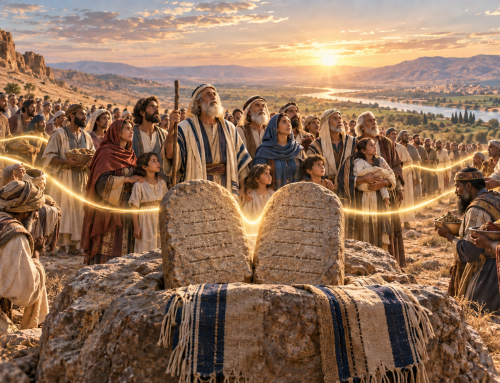
Our creator sent Moses to lead His people back to the promised land after the children of Jacob had been enslaved in Egypt for many years, enduring 10 devastating plagues. But the display of His might and His hand of protection did not end there. He miraculously divided the sea, providing them a safe passage while simultaneously destroying their enemies with the same water.
After approximately 6 weeks, they arrived at Rephidim (meaning resting places) as described in Exodus 17:1-7. Our Creator commanded them to stop at a campsite that had no water. This was not a coincidence; He had planned it and led them there. From this campsite, they were surrounded by wilderness as far as the eye could see. At this moment, their focus shifted from looking upwards at the cloud by day and the fire column by night that guided them. Instead, they turned their gaze downward to their circumstances and, in doing so, forgot about Him and His provision and protection. They no longer focused on His Promise, but rather on their circumstances and their grim fate.
This shift in focus from Him and His provision to their surroundings changed their hearts. Gratitude, hope, and trust were replaced by panic, doubt, and unbelief. The mouths that once sang songs of praise after crossing the Red Sea now accused and made demands. They quarreled with Moses, no longer believing that God was in control. They questioned how He could be in control if things did not go according to their plans. Their quarreling and demands quickly escalated to cruel accusations, openly questioning our Creator’s character, His protection, and His love. They painted His character as murderous and cruel.
Moses’s warnings fell on deaf ears, as bitterness made them unable to listen. When Moses realised that they were not heeding his warnings to not test God’s patience, he turned to God in desperation. God instructed him to demonstrate what trust and faith meant by performing the seemingly impossible. He told Moses to go to a rock in the dry wilderness and strike it with the same rod he had used to strike the Nile.
This incident served as evidence of Moses’s unwavering devotion to God and His promises, showing that he trusted in his Deliverer and never took his eyes off God.
Moreover, it demonstrated God’s gracious and life-giving presence towards undeserving people, as His character was on display through patience and abounding love.
God did not leave Moses alone to face the problem; instead, He instructed him to bring the elders along. They were to walk visibly before the people and gather at the rock where God Himself would stand with them, for His presence was their source of life.
Although they may have thought they needed water, what they truly needed was Him. In Him, they found an abundant supply for all their needs. While they may have attributed their provision to a rock, ultimately, it was God who stood upon that rock.
Unfortunately, despite God’s provision, their hearts remained hardened and unchanged. There is no record of repentance or renewed faith. In remembrance of their lack of faith and trust, Moses named the place Massah (meaning temptation/testing) and Meribah (meaning strife/quarreling).
We all encounter Rephidims in our lives, those places of rest where our Father leads us to confront our failures. These are the moments when we prioritize our own perception over God’s plan, when we lose sight of Him and become consumed by the hardships, hurts, pain, and suffering we see in and around us. Our existence becomes centered on ourselves and our surroundings, causing us to lose hope and trust, ultimately leading to the hardening of our hearts.
Reference to this incident, warning us to not harden our hearts is echoed through Scripture, Psalm 95:7-8[i], Hebrews 3:7-9[ii] and 1 Corinthians 10:3-12[iii].
The message conveyed in Exodus 17:1-7 is clear: When you reach your Rephidim, a place ment for rest and find it to be a dry and waterless place, filled with the stench of death and covered in a desolate wilderness of sand and rocks, do not lose hope. Instead, put your trust in God. Take your focus away from the bleak surroundings and place it on His protection. Have faith in Him! He guided you here and He will lead you out. He will provide for you! He will stand on the rock and give you life!
One should never rely solely on our own emotions and interpretations, as this can ultimately result in a heart becoming hardened, accompanied by feelings of pride and rebellion. The process of healing a hardened heart is a painful journey that requires one to let go of their own desires. It is often said that it is better to prevent such a situation rather than having to find a cure for it.
What a Mighty God we serve !
A God characterized by love, mercy, gravity, kindness, patience, and more. To not trust in God is to despise His Name and His character. Let us swiftly repent and cry out: “I have scorned the Name of my Creator through my doubt, disbelief, self pity and depression in my wilderness.” Then, let us redirect our focus back to Him.
Let us never disagree with the Word of our Father, never test His patience.
He cannot merely give us everything, He will give us everything. He will give us everything we need to do His will, and glorify His Name.
[i] Psalm 95:7-8 For He is our Elohim, And we are the people of His pasture, And the sheep of His hand. Today, if you would hear His voice: “Do not harden your hearts as in Meriḇah, And as in the day of Massah in the wilderness,
[ii] Heb 3:7-9 Therefore, as the Set-apart Spirit says, “Today, if you hear His voice, do not harden your hearts as in the rebellion, in the day of trial in the wilderness, where your fathers tried Me, proved Me, and saw My works forty years.
[iii] 1Corinthians 10:3-12 and all ate the same spiritual food, and all drank the same spiritual drink. For they drank of that spiritual Rock that followed, and the Rock was Messiah.
However, with most of them Elohim was not well pleased, for they were laid low in the wilderness. And these became examples for us, so that we should not lust after evil, as those indeed lusted. And do not become idolaters as some of them, as it has been written, “The people sat down to eat and to drink, and stood up to play.”
Neither should we commit whoring, as some of them did, and in one day twenty-three thousand fell, neither let us try Messiah, as some of them also tried, and were destroyed by serpents, neither grumble, as some of them also grumbled, and were destroyed by the destroyer. And all these came upon them as examples, and they were written as a warning to us, on whom the ends of the ages have come, so that he who thinks he stands, let him take heed lest he fall.


- B’reisheet: From Darkness to Eden October 5, 2026B’reisheet introduces the great storyline of Scripture: Elohim creates a good world, humanity is called to bear His image, sin brings exile and death, yet YHVH immediately begins revealing His plan of redemption and restoration through Yeshua. The Original Setting B’reisheet contains several foundational events: Elohim creates the heavens and the earth. Light […]
- The Oath That Made a People : Nitzavim September 17, 2026A commentary on Parashah Nitzavim (Deuteronomy 29:9–30:20) Scripture quotations are from the American Standard Version (1901). Verse numbers in Deuteronomy follow the Hebrew text; English Bibles run one verse higher in this section. 1. Standing in a covenant that was sworn before you were born Nitzavim opens with Israel standing — nitzavim — […]
- Ha’azinu: Luister na die Lied van die Rots September 17, 2026Die naam Ha’azinu beteken “Luister!” Hierdie Torahgedeelte, Deuteronomium 32, bevat die lied wat Moses kort voor sy dood aan Israel geleer het. Dit herinner die volk aan YHVH se trou, waarsku hulle teen geestelike afvalligheid en eindig met die hoop op herstel en versoening. Moses begin deur sy woorde met reën en dou […]
- STAAN, KIES EN WANDEL : NITZAVIM – VAYELECH August 29, 2026Nitzavim–Vayelech : Deuteronomium 29:10–31:30 Hierdie week lees ons ’n dubbele Torah-gedeelte, Nitzavim en Vayelech, en saam bring hierdie twee gedeeltes ons by een van die aangrypendste oomblikke in die Torah. In Nitzavim–Vayelech staan Israel op die vlaktes van Moab. Die woestynreis is amper verby. Die Beloofde Land lê voor hulle. Moses weet dat […]
- WANNEER JY INKOM – KI TAVO August 24, 2026DIE KERN BOODSKAPPE VAN KI TAVO: Onthou waaruit YHVH jou gebring het, wees dankbaar vir waar Hy jou gebring het, en wanneer jy Sy seën binnestap, moenie die Gewer vergeet nie. Ki Tavo (כִּי־תָבוֹא) beteken “Wanneer jy inkom.” Israel staan op die punt om die Beloofde Land binne te gaan. Ná jare in […]
- WANNEER GELOOF DEEL WORD VAN JOU ALLEDAAGSE LEWE – KI TETZE August 16, 2026Ki Tetze (כִּי־תֵצֵא) beteken “Wanneer jy uittrek” of “Wanneer jy uitgaan.” Hierdie Torah-gedeelte bevat meer gebooie as enige ander porsie en raak ’n verstommende verskeidenheid aspekte van die alledaagse lewe aan: gesinsverhoudings, die huwelik, werk, geregtigheid, die versorging van kwesbares, eerlikheid in besigheid, goedheid teenoor diere en selfs die terugbesorging van iets wat verlore […]
- SHOFTIM – WIE REGEER MY HART? August 11, 2026Die woorde waarmee hierdie gedeelte begin, bly deur die eeue heen weerklink: “Geregtigheid, geregtigheid moet jy najaag.” Deuteronomium 16:20 Shoftim (שֹׁפְטִים) beteken “regters”. Israel staan op die drumpel van die Beloofde Land, en YHVH leer hulle dat dit nie genoeg is om die land bloot in besit te neem nie. Hulle moet daarin […]
- Kies Lewe deur die Koning te Volg – Parasha Re’eh August 5, 2026"Kyk (Re'eh), Ek hou vandag voor julle die seën en die vloek." (Deut 11:26) Die eerste woord van hierdie week se Parasha is Re'eh, wat beteken "Kyk!" Dit is merkwaardig dat Moses die volk in die enkelvoud aanspreek. Al staan die hele volk voor hom, spreek hy elke persoon individueel aan. Elkeen moes […]
- Walking in the Footsteps of Covenant – Ekev July 27, 2026The Hebrew word Ekev (עקב) literally means heel or because. It carries the beautiful picture of following in someone's footsteps. Just as a heel leaves a footprint behind, Israel was called to walk in the footsteps of YHVH's covenant. The blessings described in this parashah were not random rewards, but the natural fruit of […]
- The Heart That Hears : Va’etchanan July 20, 2026The name Va'etchanan, meaning "I pleaded" or "I earnestly sought favor," reflects Moses' heartfelt plea to YHVH from the plains of Moab, begging to enter the Promised Land. Despite Elohim's loving refusal, Moses, rather than dwelling on his disappointment, dedicates his final days to preparing the Israelites for a future he will not witness. […]