As with all things in life, one cannot just look at a snapshot of David and Goliath in isolation. There is a backstory leading up to the David and Goliath confrontation.
When you read 1 Sam. 11 – 16 you get a glimpse of the ups and downs of king Saul's life. Initially the Spirit of God was with Saul and he was often victorious in battle. Samuel the prophet reminded Israel that they did an evil thing, wanting a physical king, when the Lord God was their heavenly King. Samuel reiterated these very important words "if you fear the Lord your God and serve and obey Him and do not rebel against His commands and if both you and the king who reigns over you follow the Lord your God – good! But, if you do not obey the Lord and if you rebel against His commands, His hand will be against you as it was against your fathers." Furthermore, Samuel reminded them to turn away from useless idols and to serve Him wholeheartedly.
When Saul identified a mighty or brave man, he took him into his service. Interestingly, not a blacksmith could be found in the whole land of Israel. All the blacksmiths were in Philistine country. This was a very clever and shrewd strategy of the Philistines. It turns out that on the day of battle, not every soldier had a sword or spear in his hand. Only Saul and Jonathan were sufficiently equipped. Let that sink in for a moment.
Later, Samuel gives Saul a very important instruction from the Lord to destroy the Amalekites. Read Ex. 17:8-15 and Deut. 25:17-19. The Amalekites did not fear the Lord. They waylaid the Israelites on their wilderness journey and attacked the weak and elderly when they were weary and worn out. God said He'll blot out the memory of Amalek. Saul didn't obey these specific instructions because he feared men more than God. Saul set up a monument in his own honour and his heart turned away from God.
Samuel rebuked Saul more than once. 1 Sam. 15:22b -23 "To obey is better than sacrifice and to heed is better than the fat of rams. For rebellion is like the sin of divination and arrogance like the evil of idolatry. Because you have rejected the Word of the Lord, He has rejected you as king."
The Spirit had departed from Saul. Samuel anointed David as king and the empowering Spirit of the Lord was with David.
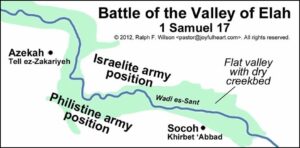
In 1 Sam. 17 we have the Philistine armies challenging the Israelite armies. In 1Sam. 17:10 Goliath said: "This day I defy the armies of Israel! On hearing the Philistine's words, Saul and all the Israelites were dismayed and terrified."
One needs to appreciate the severity of the situation. Twice a day for forty days Goliath taunts, mocks, curses and ridicules Israel. Just for a moment imagine you are a soldier in king Saul's army. Initially you might have felt courageous, but as the days wore on, the mental impact of constantly hearing the insults must have been devastating. What an assault on the senses! Goliath was very effective with his psychological warfare and as fear increased the men's morale plummeted. Abner was the commander of the army, so why didn't he take the lead? Where were all the other brave warriors in Saul's army? Why didn't Saul fight Goliath? At least he had a suit of armour.
Saul fell from grace. He was still king, but he realized he lacked the Lord's blessing and spiritual covering over his life. Did the rest of the army sense this as well? The longer the standoff dragged on, the worse it got and by day 40 the stress and anxiety must have been brutal. For 40 days they were bombarded by negative speech. The constant fear was crippling.
God sent David at exactly the right time. Unbeknownst to David his whole life of shepherding equipped him to face another giant. 1 Sam. 17:37 "The Lord who rescued me from the paw of the lion and the paw of the bear will rescue me from the hand of this Philistine." David gave honour and recognition to God. He had an unwavering faith in His Father.
David did not have all the kingly armour. He used the weapons of warfare that he was skilled in and felt comfortable with. His arms were strong and his aim precise. He did not use someone else's weapons, armour or methods. David had courage for the battle, because he trusted in God. Remember, it was not David's fight. He wasn't even part of the army, but He knew his Father.
David said to the Philistine, "You come against me with sword and spear and javelin, but I come against you in the name of the Lord Almighty, the God of the armies of Israel, whom you have defied. This day the Lord will deliver you into my hands, and I'll strike you down and cut off your head."
God is calling the "Davids" of today to be strong and courageous. He has equipped you with a unique set of abilities and skills for a time such as this. Don't compare yourself to another. Resist fear, doubt and unbelief. Declare the Word and proclaim spiritual truths. Fear the Lord and obey His voice as you go through any "Elah" valley moment.
In the world today we have many people defying the God of Abraham, Isaac and Jacob. Like Goliath they mock and ridicule and have no reverential fear. Who is your father? The gods of this world, or the one true Creator God? Do you know your Father? Choose today whom you will serve. This is a key. If you truly know Him, you will trust Him in every situation. That is how you overcome and grow in faith to stand strong and be courageous.
In your own "Elah" valley, what is your perspective? Do you have a Saul or David heart attitude to deal with the giants? The father of lies sow seeds of fear and doubt, but we have a different Spirit. Our Father is the Author and perfector of our faith. He will help us.
Like David I want to declare words from Psalm 51; create in me a pure heart, O God and renew a steadfast spirit in me. Don't take Your Holy Spirit from me. Restore to me the joy of Your salvation and grant me a willing spirit to sustain me in all my Elah valley moments.

- B’reisheet: From Darkness to Eden October 5, 2026B’reisheet introduces the great storyline of Scripture: Elohim creates a good world, humanity is called to bear His image, sin brings exile and death, yet YHVH immediately begins revealing His plan of redemption and restoration through Yeshua. The Original Setting B’reisheet contains several foundational events: Elohim creates the heavens and the earth. Light […]
- The Oath That Made a People : Nitzavim September 17, 2026A commentary on Parashah Nitzavim (Deuteronomy 29:9–30:20) Scripture quotations are from the American Standard Version (1901). Verse numbers in Deuteronomy follow the Hebrew text; English Bibles run one verse higher in this section. 1. Standing in a covenant that was sworn before you were born Nitzavim opens with Israel standing — nitzavim — […]
- Ha’azinu: Luister na die Lied van die Rots September 17, 2026Die naam Ha’azinu beteken “Luister!” Hierdie Torahgedeelte, Deuteronomium 32, bevat die lied wat Moses kort voor sy dood aan Israel geleer het. Dit herinner die volk aan YHVH se trou, waarsku hulle teen geestelike afvalligheid en eindig met die hoop op herstel en versoening. Moses begin deur sy woorde met reën en dou […]
- STAAN, KIES EN WANDEL : NITZAVIM – VAYELECH August 29, 2026Nitzavim–Vayelech : Deuteronomium 29:10–31:30 Hierdie week lees ons ’n dubbele Torah-gedeelte, Nitzavim en Vayelech, en saam bring hierdie twee gedeeltes ons by een van die aangrypendste oomblikke in die Torah. In Nitzavim–Vayelech staan Israel op die vlaktes van Moab. Die woestynreis is amper verby. Die Beloofde Land lê voor hulle. Moses weet dat […]
- WANNEER JY INKOM – KI TAVO August 24, 2026DIE KERN BOODSKAPPE VAN KI TAVO: Onthou waaruit YHVH jou gebring het, wees dankbaar vir waar Hy jou gebring het, en wanneer jy Sy seën binnestap, moenie die Gewer vergeet nie. Ki Tavo (כִּי־תָבוֹא) beteken “Wanneer jy inkom.” Israel staan op die punt om die Beloofde Land binne te gaan. Ná jare in […]
- WANNEER GELOOF DEEL WORD VAN JOU ALLEDAAGSE LEWE – KI TETZE August 16, 2026Ki Tetze (כִּי־תֵצֵא) beteken “Wanneer jy uittrek” of “Wanneer jy uitgaan.” Hierdie Torah-gedeelte bevat meer gebooie as enige ander porsie en raak ’n verstommende verskeidenheid aspekte van die alledaagse lewe aan: gesinsverhoudings, die huwelik, werk, geregtigheid, die versorging van kwesbares, eerlikheid in besigheid, goedheid teenoor diere en selfs die terugbesorging van iets wat verlore […]
- SHOFTIM – WIE REGEER MY HART? August 11, 2026Die woorde waarmee hierdie gedeelte begin, bly deur die eeue heen weerklink: “Geregtigheid, geregtigheid moet jy najaag.” Deuteronomium 16:20 Shoftim (שֹׁפְטִים) beteken “regters”. Israel staan op die drumpel van die Beloofde Land, en YHVH leer hulle dat dit nie genoeg is om die land bloot in besit te neem nie. Hulle moet daarin […]
- Kies Lewe deur die Koning te Volg – Parasha Re’eh August 5, 2026"Kyk (Re'eh), Ek hou vandag voor julle die seën en die vloek." (Deut 11:26) Die eerste woord van hierdie week se Parasha is Re'eh, wat beteken "Kyk!" Dit is merkwaardig dat Moses die volk in die enkelvoud aanspreek. Al staan die hele volk voor hom, spreek hy elke persoon individueel aan. Elkeen moes […]
- Walking in the Footsteps of Covenant – Ekev July 27, 2026The Hebrew word Ekev (עקב) literally means heel or because. It carries the beautiful picture of following in someone's footsteps. Just as a heel leaves a footprint behind, Israel was called to walk in the footsteps of YHVH's covenant. The blessings described in this parashah were not random rewards, but the natural fruit of […]
- The Heart That Hears : Va’etchanan July 20, 2026The name Va'etchanan, meaning "I pleaded" or "I earnestly sought favor," reflects Moses' heartfelt plea to YHVH from the plains of Moab, begging to enter the Promised Land. Despite Elohim's loving refusal, Moses, rather than dwelling on his disappointment, dedicates his final days to preparing the Israelites for a future he will not witness. […]