After last week’s spiritual look at the split hooved animals of Lev 11, I paged back to look at the burned offerings of Lev 1.
There are three types of burnt offerings mentioned. The first two types mention a bull, a sheep or a goat—all males without blemish. The third offering, however, is plural—doves or pigeons. There is no mention that they must be without blemish. Let’s recall the 3 options, before we continue.
If the offering is a bull:
- It must be brought to the door of the Tent of Meeting (To the east of the Altar)
- He shall lay his hand on the head of the bull to make atonement on his behalf.
- He must slaughter the bull himself
- The priests will take the blood and sprinkle it around the altar.
- He must skin the bull and cut it into pieces.
- The priests will put fire and wood on the altar.
- The priests will put the pieces on the altar.
- The entrails and legs must be washed by the one making atonement.
- The priests will burn it all on the altar as a pleasing aroma.
If the offering is a sheep or goat:
- It must be slaughtered North of the altar.
- The priests will take the blood and sprinkle it against the sides of the altar.
- It is not skinned, but the one making the offering must cut it into pieces.
- The priests will put the pieces on the altar.
- The entrails and legs must be washed by the one making atonement.
- The priests will burn it all on the altar as a pleasing aroma.
If the offering is of birds:
- One is not enough; it should be a pair.
- The priest shall bring it to the altar and wring off its head and burn it on the altar.
- Its blood shall be drained out on the side of the altar.
- He shall remove its crop with its contents and cast it beside the altar on the east side, in the place for ashes.
- He shall tear it open by its wings but shall not sever it completely.
- The priests will burn it all on the altar as a pleasing aroma.
Like in Lev 11, we find more than just a list of dos and don’ts on the list of burnt offerings. My aim with this short writing is instil a desire to delve into this yourself and discover more of the sanctification gems in Leviticus.
At first glance it seemed to be offerings according to what you can afford, but that is not mentioned in Scripture. But if Leviticus is the book of Sanctification, a road map to Restoration to Eden, what can we learn from the burnt offerings.
Instead of looking with material eyes at chapter 1, let’s look at it through the lenses of spiritual maturity. Not rich to poor, but as mature spiritual beings, young men, and spiritual babies. Much like Paul is describing in 1 Cor 3:1-2 “And I, brothers, was not able to speak to you as to spiritual ones but as to fleshly, as to babes in Messiah. I fed you with milk and not with solid food, for until now you were not able to receive it, and even now you are still not able,”
If you are mature, more effort or accountability is required from you. Your offer is bigger, and the labour expected from you is harder. You must kill, skin, and cut into pieces. Slaughtering a bull is an enormous job. Why a greater job for a more mature believer? For you should feel the consequences of your wrong deeds more than those that are still learning.
After our study of the split hooved animals that chew the cud, it stood out—the two requirements in Lev 11 are the two parts of the animals that needed washing. The one bringing the offering had to wash the legs with the split hooves, and the entrails when the animal chews the cud.
For as a mature believer, you should by now know how-to walk-in righteousness—building on the Rock through meditation on the Word. The lack of those two actions is what caused you to need to bring a burnt offering for atonement.
Then we have the spiritual young men, bringing the sheep or goat. A Smaller animal that is easier to slaughter. Less is required from the one bringing the offering. He, for instance, does not need to skin the sheep. It is, however, still required of him the wash the entrails and the legs—pointing to the same lesson mentioned above.
Over a cup of coffee, my mom and I talked about the offerings of a spiritual baby. What made their offerings so unique?
A bull and a sheep will come almost willingly, led on a rope around their necks. But have you ever tried to carry two doves? They do not sit still, but flutter with their wings. Trying to hold on is effort and they do not seem to come willingly at all.
The priest does the killing for this person in almost a deed of compassion, draining its blood on the altar. Then he hands the lifeless birds back to the one bringing the offering. The crop is removed and not washed but cast away. For a young believer does not meditate on the Word yet and sometimes eats what is not pure in his learning process.
The one bringing the offering must tear open the birds to spread their wings. This brings Ex 24:20 to mind, where the cherubim are described with their wings spread open over the mercy seat. Here an offer of two birds with open wings are put on the altar, to burn as a pleasing aroma. A reminder of wings not only over the mercy seat—where atonement is made for wilful sins—but also a reminder of the graceful wings that Father carried us on out of Egypt. (Ex 19:4)
What an awesome God we serve, at first as young believers we are reminded of His mercy and love and grace through the imagery of the wings. We are also reminded that we are still young and do not always acknowledge our sins. We flutter our wings and need the help of a priest to do the killing. Nothing willing yet. And all that is needed from us is after our sins are dealt a final blow, is to get rid of the wrong food we ate, not pure Word to meditate on. And then to rely on Fathers Mercy for growth.
Another obvious progression I noticed was the sprinkling of the blood. The bull’s blood is sprinkled around the altar, the sheep/ goat’s blood sprinkled on the altar, but the blood of the birds is not caught up and sprinkled but drained directly from the bird onto the altar.
The bronze altar symbolises judgement, a place where we deal with the physical, the laying down of ourselves as we mature spiritually.
With a more mature believer the physical should be more separated from the spiritual—the blood of his offering is sprinkled around the altar.
In a young believer the physical is still present, but not prominent. The blood of his offering is sprinkled onto the altar.
With a baby in faith, the physical and spiritual are still very mixed. The blood of his offering is totally drained onto the altar.
As we mature, we move from birds to a sheep or goat and hopeful not a lot of bulls will be needed in our lives.
Let us mature together in our journey to Eden. To be His image bearers, His royal priesthood. It is our duty to assist the young in faith with love, kindness, compassion, and mercy as we grow.
All to the glory of our Creator, our King and our loving Father!


- Mattot : Faithful Words, Faithful Hearts July 7, 2026Parashat Mattot poses three timeless questions: Are our words trustworthy? Are we removing compromise from our lives? Are we committed to the wellbeing of Father’s people as much as our own family? The portion of Mattot begins with instructions about vows and oaths. In a world where words can be spoken lightly and […]
- Pinchas: Zeal that Brings Life June 28, 2026Parashat Pinchas opens in the wake of a somber chapter in Israel's history. The people had succumbed to idolatry and immorality at Baal Peor, inviting divine judgment upon the camp. Amidst this crisis, Pinchas demonstrated zealous devotion to the holiness of YHVH, and his actions averted Elohim's anger. Consequently, he was granted a "covenant […]
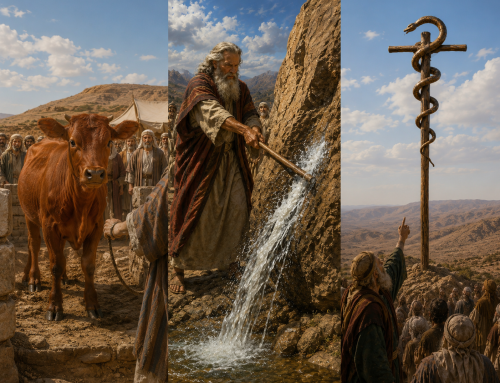
- Prophetic images of hope : Pictures of Messiah in Chukat June 23, 2026Parashat Chukat, Numbers 19:1-22:1, contains some of the most mysterious passages in the Torah : The accounts of the water from the Rock, the Red Heifer and the bronze Serpent beautifully bridge the Torah and the Good News, showing that even in the wilderness YHVH was already revealing His plan of redemption through Messiah […]
- Korach : The Subtle Seed of Rebellion June 14, 2026Parashat Korach (Numbers 16-18) is far more than the story of a man who challenged Moses. It is a warning about the subtle seed of rebellion that can grow in any heart. Korach was a Levite, chosen for a sacred calling, yet he became dissatisfied with the role YHVH had given him. Under […]
- From Fear to Faith: Learning from the Spies June 9, 2026Parashat Sh’lach (Numbers 13–15) tells the dramatic story of the twelve spies sent to explore the Promised Land. All twelve saw the same land flowing with milk and honey. All twelve carried the same giant cluster of grapes back to Israel. Yet only two, Joshua and Caleb, returned with faith. The other ten […]
- The Tongue: From Fire to Restoration May 31, 2026Last week, in Nosa (Numbers 4:21-7:89), we discussed the priestly blessing as a model of restoration, where people are lifted up and blessed. This week, in Beha'alotcha (Numbers 8:1-12:16), we see a practical illustration of this in the lives of Moses and Miriam. James 3:5-10 paints a vivid and unsettling picture of the […]
- Heaven’s Voice, Echoed on Earth May 26, 2026Comparing the Priestly blessing in Numbers 6:24-26 with the Lord’s prayer in Matthew 6:9-13, we find a beautiful symmetry in Scripture, like and echo reflecting back. One is spoken over the people, the other through the people, yet both flow from the same divine heart. The Priestly Blessing begins, “יהוה bless you and […]
- Ruth 4: The Redeemer at the Gate — A Messianic Reflection May 19, 2026Ruth 4 brings the story to the city gate—the place of decision, witness, and redemption. What has been unfolding in quiet fields now steps into the light. Boaz meets the nearer kinsman-redeemer before the elders. The right to redeem Naomi’s land is offered, but when the cost becomes clear—marrying Ruth and raising up […]
- Ruth 3: At the Threshing Floor May 19, 2026The chapter unfolds in the stillness of night, on a threshing floor where grain is separated and hearts are laid bare. What began in famine is now progressing toward redemption—but not without intention, courage, and trust. Naomi tells Ruth to approach Boaz, the kinsman-redeemer, and make a bold request. Ruth humbly goes to […]
- Ruth 2 : Grace in the field May 19, 2026Like seeds hidden beneath the earth, the chapter artfully shifts the story from a feeling of emptiness to one of provision, a change that occurs with remarkable quietness. Ruth goes to the fields to collect what's left, fulfilling the role of the poor and the foreigner. It appears to be a fortunate coincidence […]