In this week’s Torah Portion ‘Vayetze’ (he went out), the focus is on Jacob’s stay in Haran, carrying the same two themes at both ends of the “visit” .
In the beginning of this portion, we see Jacob, fleeing to Haran, due to his fear of Esau. He leaves the house of his father Isaac. A stone is placed under his head for him to rest on. That night Jacob has a dream about Angels going up and down a ladder. He decided to name the place where he had his dream.
The portion ends with Jacob fleeing from Haran, leaving the house of his father-in-law and stones are stacked to form a pilar as sign of peace between Jacob and Laban. Jacob is met by angels on the way. Again, Jacob names this place following his encounter and the portion ends with Jacob now willing to face Esau, which was his biggest fear!
What happened between these two bookends of the Torah portion and how did it affect Jacob’s life?
Jacob, the one who deceived his father Isaac, was confronted, and deceived by Laban into marrying Leah instead of Rachel (Gen 29:23). After the deception he confronted Laban and was rewarded with the bride he bargained for initially.
Laban deceived Jacob again after begging him to stay, saying that he may make his price (Gen 30:35). This time, Jacob decided not to confront Laban, but to make a run for it. This time he did not react out of his own will; he acted on God’s instruction to go.
Jacob changed.
He surrendered his life and destiny to Father. No longer was he making his own plans, forcing God’s timeline to deliver on the promises made.
The slight differences in the two book ends become clear:
In leaving for Haran, he was acting in accordance with his own fear as well as the advice of both his father and mother. It was a ‘second hand revelation’ from the Creator. It was a revelation given to his forefathers, and not to him directly. Jacob knew that he was chosen to be the image bearer of our Creator, and to be a part of the promises made to Abraham. However, this was only theoretical knowledge.
That night, in total exhaustion, he rested his head on the rock.
Why was it mentioned that he put a rock under his head before he fell asleep? Is Isaiah 51:1-2 an echo of what went through Jacob’s mind?
Isa 51:1-2 “Listen to me, you who pursue righteousness, you who seek the LORD! Look to the rock from which you were cut, to the quarry from which you were hewn. Look to Abraham your father, and to Sarah who gave you birth. For when he was only one person I called him, but I made him fruitful and made him many.
Listen to me, you who pursue righteousness, you who do the upright thing. Was Jacob in pursuit of righteousness? Perhaps he was trying to correct his previous wrongdoings by being obedient to the will of his parents? In Gen 28:1-2 he was asked to marry a daughter of Laban, not a Canaanite, the cursed generation of Ham. Here he was, on his way to Haran, doing not only what Isaac requested him to do, but also what Abraham did for Isaac, acquiring a bride from Haran. He was returning to the ways of his fathers, to the rock from which he was cut.
While fast asleep with his head on the rock, he had a dream. It was of an encounter with angels coming and going. He had a vision of our Creator, and the Abrahamic covenant was confirmed. He was called to be the image bearer of our Father. Jacob was called to be His representative to the nations around him.
We see the change in Jacob’s heart through his actions and reactions in Gen 31. He now reacts on the direct instruction of our Creator and not on his own emotion or fear. Jacob’s fear for Esau did not prevent him from acting in obedience. He did not fight Laban when he was pursued. He displayed trust in Father, like Abraham did when he was asked to sacrifice his son, Isaac. He displayed the same lack of violence Isaac had when confronted at the wells he reopened.
He was being shaped into an image bearer. He was being prepared for the next encounter with our Creator.


- Mattot : Faithful Words, Faithful Hearts July 7, 2026Parashat Mattot poses three timeless questions: Are our words trustworthy? Are we removing compromise from our lives? Are we committed to the wellbeing of Father’s people as much as our own family? The portion of Mattot begins with instructions about vows and oaths. In a world where words can be spoken lightly and […]
- Pinchas: Zeal that Brings Life June 28, 2026Parashat Pinchas opens in the wake of a somber chapter in Israel's history. The people had succumbed to idolatry and immorality at Baal Peor, inviting divine judgment upon the camp. Amidst this crisis, Pinchas demonstrated zealous devotion to the holiness of YHVH, and his actions averted Elohim's anger. Consequently, he was granted a "covenant […]
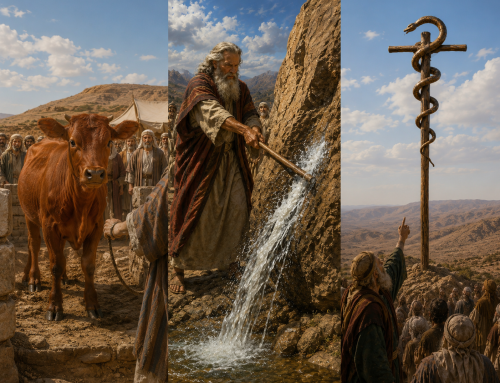
- Prophetic images of hope : Pictures of Messiah in Chukat June 23, 2026Parashat Chukat, Numbers 19:1-22:1, contains some of the most mysterious passages in the Torah : The accounts of the water from the Rock, the Red Heifer and the bronze Serpent beautifully bridge the Torah and the Good News, showing that even in the wilderness YHVH was already revealing His plan of redemption through Messiah […]
- Korach : The Subtle Seed of Rebellion June 14, 2026Parashat Korach (Numbers 16-18) is far more than the story of a man who challenged Moses. It is a warning about the subtle seed of rebellion that can grow in any heart. Korach was a Levite, chosen for a sacred calling, yet he became dissatisfied with the role YHVH had given him. Under […]
- From Fear to Faith: Learning from the Spies June 9, 2026Parashat Sh’lach (Numbers 13–15) tells the dramatic story of the twelve spies sent to explore the Promised Land. All twelve saw the same land flowing with milk and honey. All twelve carried the same giant cluster of grapes back to Israel. Yet only two, Joshua and Caleb, returned with faith. The other ten […]
- The Tongue: From Fire to Restoration May 31, 2026Last week, in Nosa (Numbers 4:21-7:89), we discussed the priestly blessing as a model of restoration, where people are lifted up and blessed. This week, in Beha'alotcha (Numbers 8:1-12:16), we see a practical illustration of this in the lives of Moses and Miriam. James 3:5-10 paints a vivid and unsettling picture of the […]
- Heaven’s Voice, Echoed on Earth May 26, 2026Comparing the Priestly blessing in Numbers 6:24-26 with the Lord’s prayer in Matthew 6:9-13, we find a beautiful symmetry in Scripture, like and echo reflecting back. One is spoken over the people, the other through the people, yet both flow from the same divine heart. The Priestly Blessing begins, “יהוה bless you and […]
- Ruth 4: The Redeemer at the Gate — A Messianic Reflection May 19, 2026Ruth 4 brings the story to the city gate—the place of decision, witness, and redemption. What has been unfolding in quiet fields now steps into the light. Boaz meets the nearer kinsman-redeemer before the elders. The right to redeem Naomi’s land is offered, but when the cost becomes clear—marrying Ruth and raising up […]
- Ruth 3: At the Threshing Floor May 19, 2026The chapter unfolds in the stillness of night, on a threshing floor where grain is separated and hearts are laid bare. What began in famine is now progressing toward redemption—but not without intention, courage, and trust. Naomi tells Ruth to approach Boaz, the kinsman-redeemer, and make a bold request. Ruth humbly goes to […]
- Ruth 2 : Grace in the field May 19, 2026Like seeds hidden beneath the earth, the chapter artfully shifts the story from a feeling of emptiness to one of provision, a change that occurs with remarkable quietness. Ruth goes to the fields to collect what's left, fulfilling the role of the poor and the foreigner. It appears to be a fortunate coincidence […]