YHVH Nissi translates as “YHVH is my banner”, or “YHVH my sign of victory”.
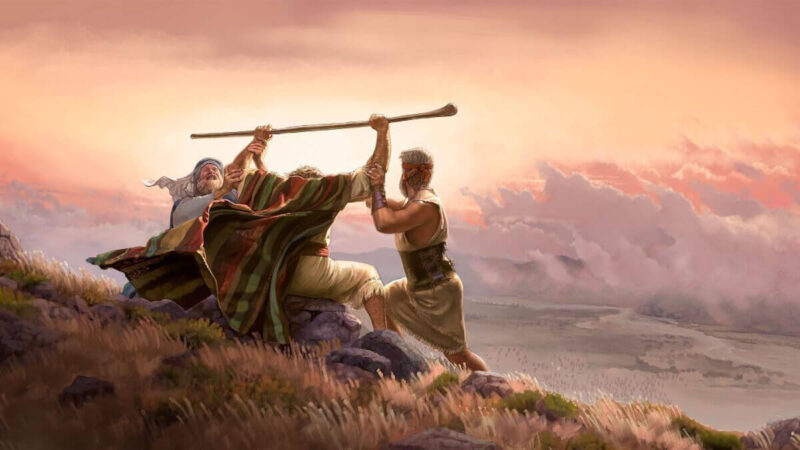
We’re introduced to this name in Ex 17:12-16: And Aaron and Ḥur supported his hands, one on one side, and the other on the other side. And Joshua defeated Amalĕq and his people with the edge of the sword. Andיהוה said to Moses, “Write this for a remembrance in the book and recite it in the hearing of Joshua, that I shall completely blot out the remembrance of Amalĕq from under the heavens.” And Moses built an altar and called its name, יהוה Nissi, for he said, “Because a hand is on the throne of Yah, יהוה is to fight against Amalĕq, from generation to generation.” Let the weight, the gravitas, of the words: And Mosheh built an altar and called its name, יהוה Nissi, sink in. Moses called an altar “YHVH my banner, my sign of victory.”
The word nissi is derived from nes (nune, samekh) and refers to, among others, the sign or insignia, of a king at war. It defines and identifies the king and his men and distinguishes them from their enemies. Find an altar and you find a king with his army assembled in battle array. Every altar has a king, and every king has an altar as his sign, his banner.
We’ve said nes means sign, and we find this word also in Matt 16:4: [N]o sign shall be given to it except the sign of the prophet Jonah. The altar, the banner of the Messiah! This is seen clearly when realising that nes is also translated as pole, or signpost, such as in Num 21:8: Andיהוה said to Moses, “Make a fiery serpent, and set it on a [sign] pole (nes).” We read about this event in John 3:14-15 as wello: And as Moses lifted up the serpent in the wilderness, even so the Son of Aḏam has to be lifted up, so that whoever is believing in Him should not perish but possess everlasting life. The altar Moses erected is a sign and a prophecy of Him, The Sign, who has been lifted up and sacrificed – The KING – with an inscription, a banner, above His head that reads: Yeshua ha-Notzrti uMelekh hayehudim, The King of the Jews.
Amalek, filled with pride, is still biting from the rear like a snake at the heel, still intimidating God’s people into fear, doubt and unbelief. He battles the King and His army from generation to generation, but in the end he will be blotted out, crushed if you wish. It is at the altar of the King where His people are victorious – a miraculous overcoming. Do you know that the word nes also means miracle? At the altar of the cross, Amalek had been crushed by the Miracle worker, the high and lifted up King with a sign engraved as banner above His head. The war against Amalek, the arrogant one, can only be won under the banner, at the altar, of the King. Does it come as a surprise that, at the end of days, an altar in Jerusalem will be the place of battle between The King and the arrogant one? Let His altar be our banner – He is YHVH Nissi.

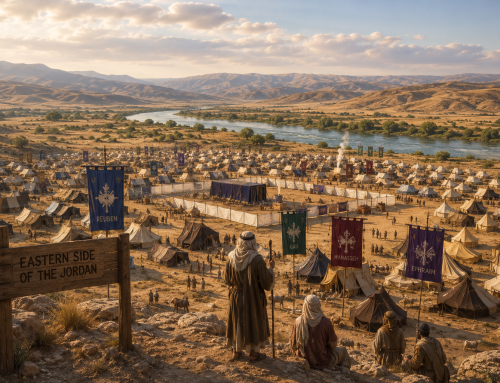
- Remember the Road, Prepare for the Promise (Devarim) July 15, 2026As the book of Devarim (Deuteronomy) begins, Israel stands on the eastern side of the Jordan River. The wilderness journey is nearly complete. A new generation is poised to enter the Promised Land, but before crossing over, Moses pauses. Instead of delivering military orders, he starts with a sermon. Before Israel can claim […]
- Mattot : Faithful Words, Faithful Hearts July 7, 2026Parashat Mattot poses three timeless questions: Are our words trustworthy? Are we removing compromise from our lives? Are we committed to the wellbeing of Father’s people as much as our own family? The portion of Mattot begins with instructions about vows and oaths. In a world where words can be spoken lightly and […]
- Pinchas: Zeal that Brings Life June 28, 2026Parashat Pinchas opens in the wake of a somber chapter in Israel's history. The people had succumbed to idolatry and immorality at Baal Peor, inviting divine judgment upon the camp. Amidst this crisis, Pinchas demonstrated zealous devotion to the holiness of YHVH, and his actions averted Elohim's anger. Consequently, he was granted a "covenant […]
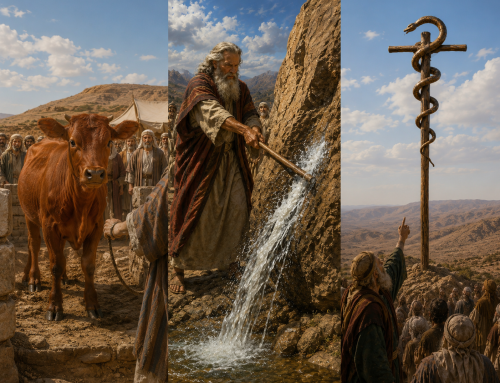
- Prophetic images of hope : Pictures of Messiah in Chukat June 23, 2026Parashat Chukat, Numbers 19:1-22:1, contains some of the most mysterious passages in the Torah : The accounts of the water from the Rock, the Red Heifer and the bronze Serpent beautifully bridge the Torah and the Good News, showing that even in the wilderness YHVH was already revealing His plan of redemption through Messiah […]
- Korach : The Subtle Seed of Rebellion June 14, 2026Parashat Korach (Numbers 16-18) is far more than the story of a man who challenged Moses. It is a warning about the subtle seed of rebellion that can grow in any heart. Korach was a Levite, chosen for a sacred calling, yet he became dissatisfied with the role YHVH had given him. Under […]
- From Fear to Faith: Learning from the Spies June 9, 2026Parashat Sh’lach (Numbers 13–15) tells the dramatic story of the twelve spies sent to explore the Promised Land. All twelve saw the same land flowing with milk and honey. All twelve carried the same giant cluster of grapes back to Israel. Yet only two, Joshua and Caleb, returned with faith. The other ten […]
- The Tongue: From Fire to Restoration May 31, 2026Last week, in Nosa (Numbers 4:21-7:89), we discussed the priestly blessing as a model of restoration, where people are lifted up and blessed. This week, in Beha'alotcha (Numbers 8:1-12:16), we see a practical illustration of this in the lives of Moses and Miriam. James 3:5-10 paints a vivid and unsettling picture of the […]
- Heaven’s Voice, Echoed on Earth May 26, 2026Comparing the Priestly blessing in Numbers 6:24-26 with the Lord’s prayer in Matthew 6:9-13, we find a beautiful symmetry in Scripture, like and echo reflecting back. One is spoken over the people, the other through the people, yet both flow from the same divine heart. The Priestly Blessing begins, “יהוה bless you and […]
- Ruth 4: The Redeemer at the Gate — A Messianic Reflection May 19, 2026Ruth 4 brings the story to the city gate—the place of decision, witness, and redemption. What has been unfolding in quiet fields now steps into the light. Boaz meets the nearer kinsman-redeemer before the elders. The right to redeem Naomi’s land is offered, but when the cost becomes clear—marrying Ruth and raising up […]
- Ruth 3: At the Threshing Floor May 19, 2026The chapter unfolds in the stillness of night, on a threshing floor where grain is separated and hearts are laid bare. What began in famine is now progressing toward redemption—but not without intention, courage, and trust. Naomi tells Ruth to approach Boaz, the kinsman-redeemer, and make a bold request. Ruth humbly goes to […]